Overview
You are rival flower growers building valuable arrangements while controlling which blooms reach the table. Grow legal Bouquets, block competing growers, call in Favors to reclaim the Flowers you need, and use Parlay cards to help your garden—or sabotage theirs. Harvest the most valuable collection before the season ends. Highest score wins.
What you are doing
Grow legal 3-card bouquets in your Flower Beds, then Harvest them into your Harvested Area for points.
Cards can be played face-up as Flowers or face-down as Compost. In larger games, Wildflowers and Parlay cards add more chaos and flexibility.
Three big ideas
- Compatibility matters. Flower icons show which bouquets are legal.
- Blocking matters. Opponents’ face-up Flowers can stop you from growing that Flower type.
- Timing matters. Once a bouquet is complete, you must Harvest it on your turn.
Components
Full game
56 Base Flower cards
18 Wildflower cards
12 Parlay cards
4 double-sided Award cards
1 Favor token per player
1 Substitute token/cube per player
Total cards: 90
Base game
56 Base Flower cards, 4 double-sided Award cards, and 1 Favor token per player.
Use this for the standard 2–4 player experience.
Wildflower / Parlay module
Designed for 5–6 players, but may be added to any player count.
If using Wildflowers in smaller games and it feels too easy, remove Favor tokens and reduce Wildflowers.
Base Flower Deck
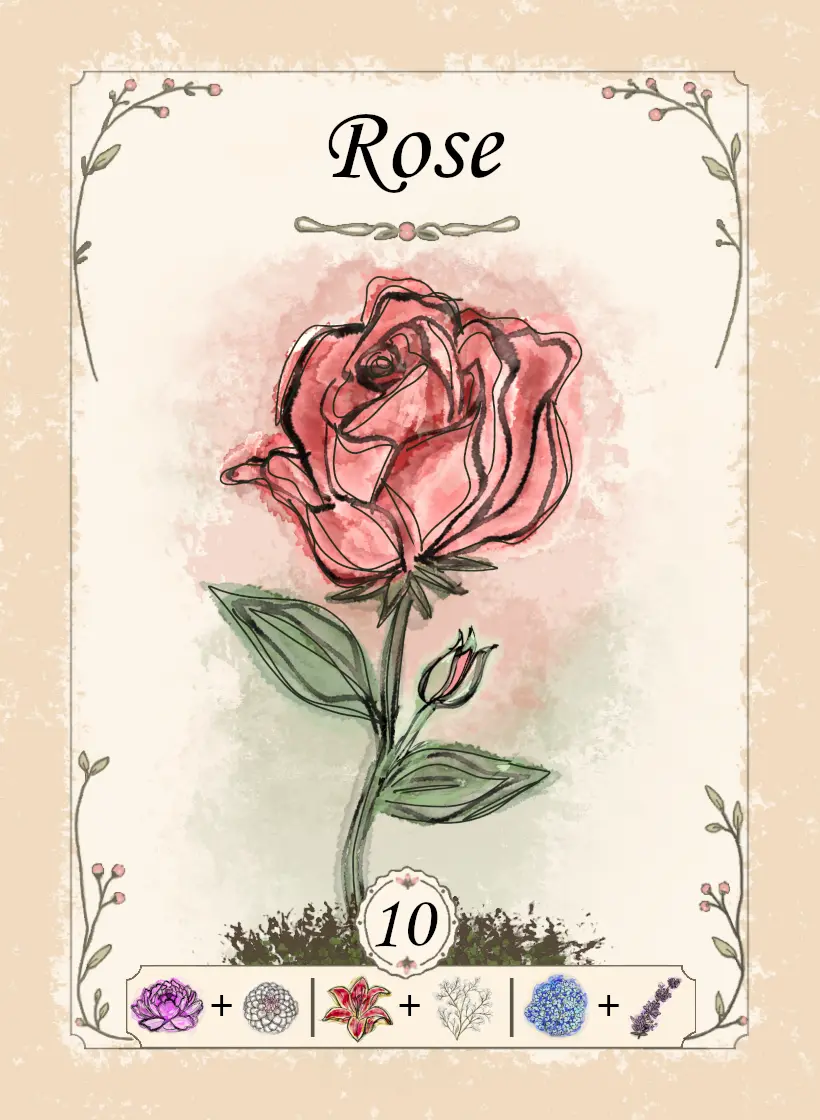
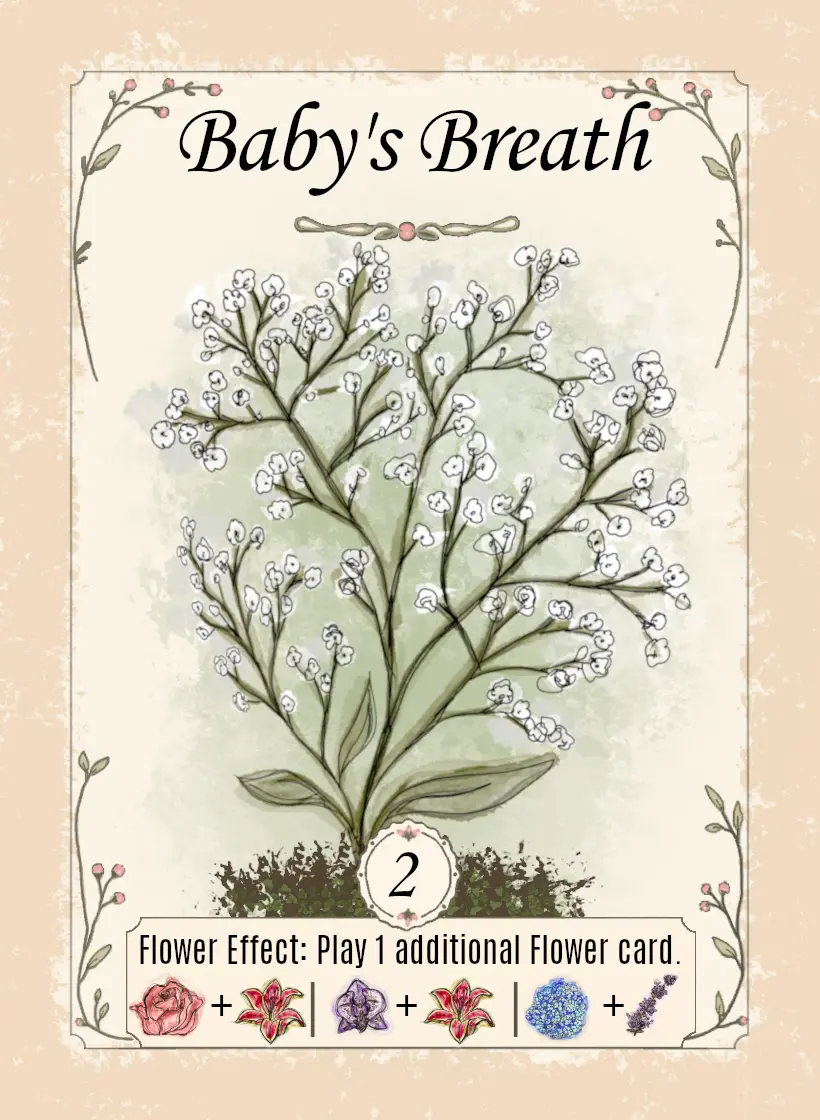
The base game is built around 12 Flower types.
Wildflower & Parlay add-on
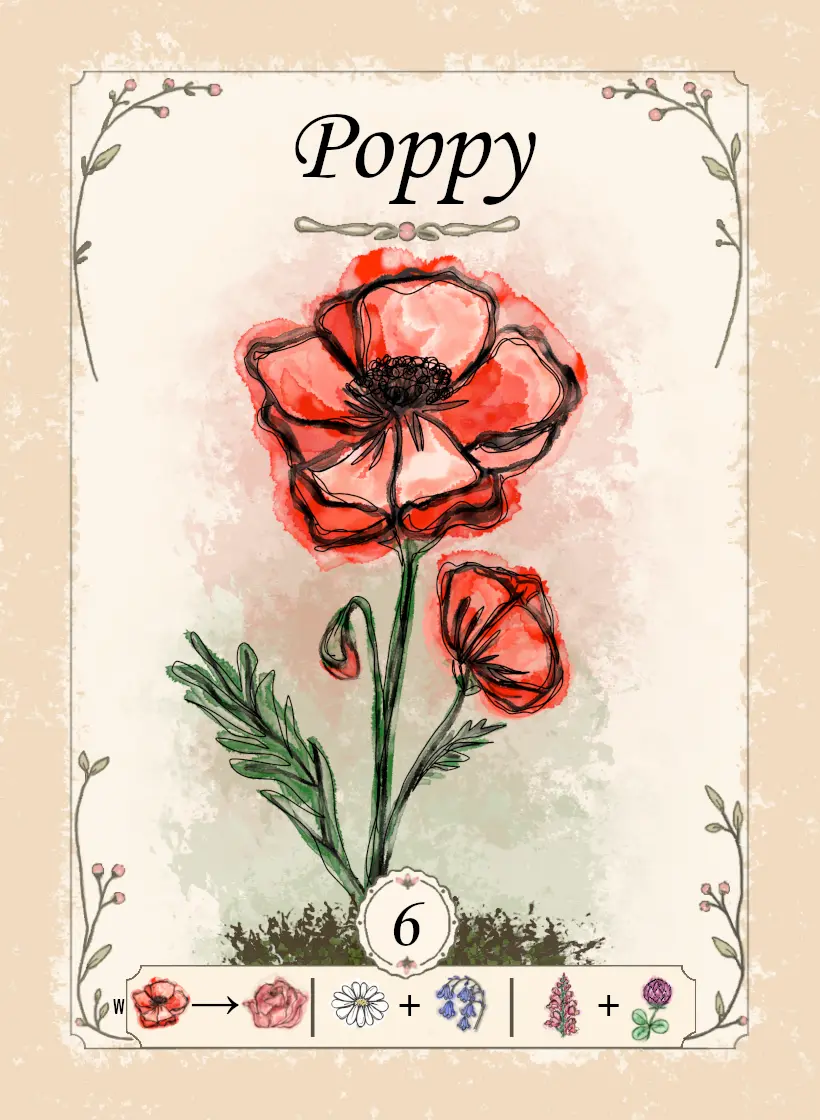
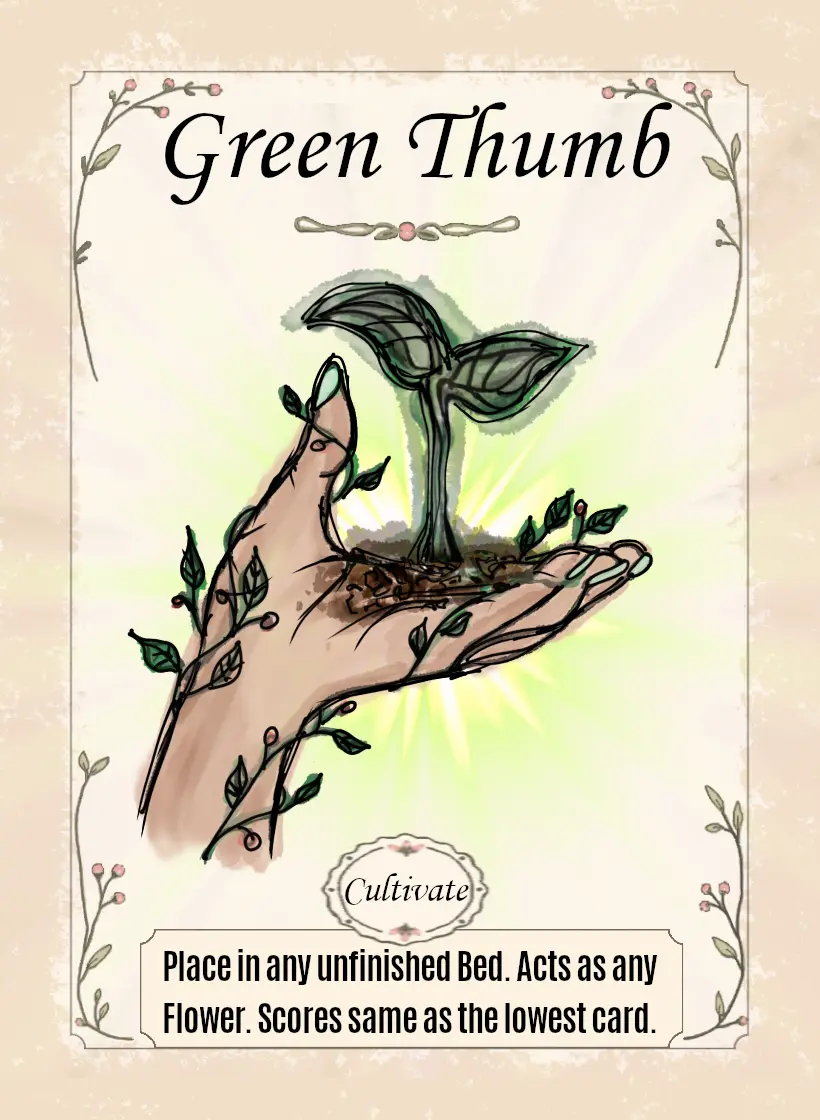
Wildflowers can substitute for certain Base Flowers. Parlay cards either help you or mess with opponents.
| Base Flower | Copies | Points |
|---|---|---|
| Rose | 4 | 10 |
| Sunflower | 4 | 9 |
| Lily | 4 | 8 |
| Dahlia | 4 | 7 |
| Tulip | 5 | 6 |
| Peony | 5 | 6 |
| Lavender | 5 | 5 |
| Carnation | 5 | 5 |
| Hydrangea | 5 | 4 |
| Orchid | 5 | 4 |
| Ivy | 5 | 3 |
| Baby’s Breath | 5 | 2 |
Setup
Build the Flower Deck
2 players: remove 1 copy of each Base Flower, then shuffle the remaining 44 Base Flower cards. Do not use Wildflowers in the normal 2-player game.
3–4 players: shuffle all 56 Base Flower cards.
5–6 players: shuffle all 56 Base Flower cards with all 18 Wildflower cards for a 74-card Flower Deck. Shuffle the 12 Parlay cards separately.
Pick first player
Pick the first player. Deal and play clockwise.
Deal starting hands
| Players | Starting hands |
|---|---|
| 2 | 4 / 4 |
| 3 | 3 / 3 / 4 |
| 4 | 3 / 3 / 4 / 4 |
| 5 | 3 / 3 / 3 / 3 / 3 |
| 6 | 3 / 3 / 3 / 4 / 4 / 4 |
Place the rest of the Flower cards face-down as the Flower Deck.
Give tokens
Each player gets 1 Favor token. Each player also gets 1 Substitute token/cube if Wildflowers are being used.
Set Awards
2–4 players: reveal 1 Award card side and use all 3 Awards shown.
5–6 players: reveal 2 Award card sides. Use all 3 Awards from one side and 2 Awards from the second side for a total of 5 active Awards.
How your Growing Area works
Each player has a Growing Area with up to 2 Flower Beds. Each Flower Bed may hold up to 3 cards. A completed legal Flower Bed can be Harvested and becomes a Bouquet.
What can be in a Bed?
Face-up Flowers, face-down Compost, Wildflowers, Wildflowers used as substitutes, and Pigweed.
How cards can be played
Play a card as 1 face-up Flower or 1 face-down Compost. A Wildflower may also be played as the substitute Flower shown by its icons.
Legal completed Beds
3 compatible Flowers, 2 compatible Flowers + 1 Compost, or 1 Flower + 2 Compost. 3 Compost cards are never legal.
How to read a Flower card
Base Flower example
Each box at the bottom shows the other two Flowers that can join this card to make a legal 3-card bouquet.
- Rose + Peony + Dahlia
- Rose + Lily + Baby’s Breath
- Rose + Hydrangea + Lavender
What the icons mean
Think of the icons as 3 recipe boxes. If one box is fully satisfied, that Flower Bed is legal for that card.
You are not building random trios. You are matching one of the card’s printed pair options.
| Bouquet name | Flowers | Points |
|---|---|---|
| The Big Deal | Rose + Peony + Dahlia | 23 |
| Grand Opening | Sunflower + Dahlia + Tulip | 22 |
| Garden Party | Sunflower + Peony + Carnation | 20 |
| Marry Me | Rose + Lily + Baby’s Breath | 20 |
| Anniversary Save | Rose + Hydrangea + Lavender | 19 |
| Grandma’s Vase | Dahlia + Peony + Ivy | 16 |
| Secret Admirer | Tulip + Lavender + Carnation | 16 |
| Obligatory Gift | Sunflower + Hydrangea + Ivy | 16 |
| Prom Night | Lily + Orchid + Ivy | 15 |
| Please Don’t Be Mad | Tulip + Carnation + Orchid | 15 |
| Funeral Fancy | Lily + Baby’s Breath + Orchid | 14 |
| Clearance Rack | Hydrangea + Baby’s Breath + Lavender | 11 |
Flower Effects
A Flower Effect triggers only when that card is played face-up as a Flower. Resolve the effect on the card. Flower Effects do not chain.
Baby’s Breath
Card text: Flower Effect: Play 1 additional Flower card.
Complete rule: After playing Baby’s Breath face-up legally, immediately play 1 additional Flower card from your hand face-up into a legal Bed. The additional card’s Flower Effect does not trigger. If you cannot make a legal additional Flower play, the effect ends.
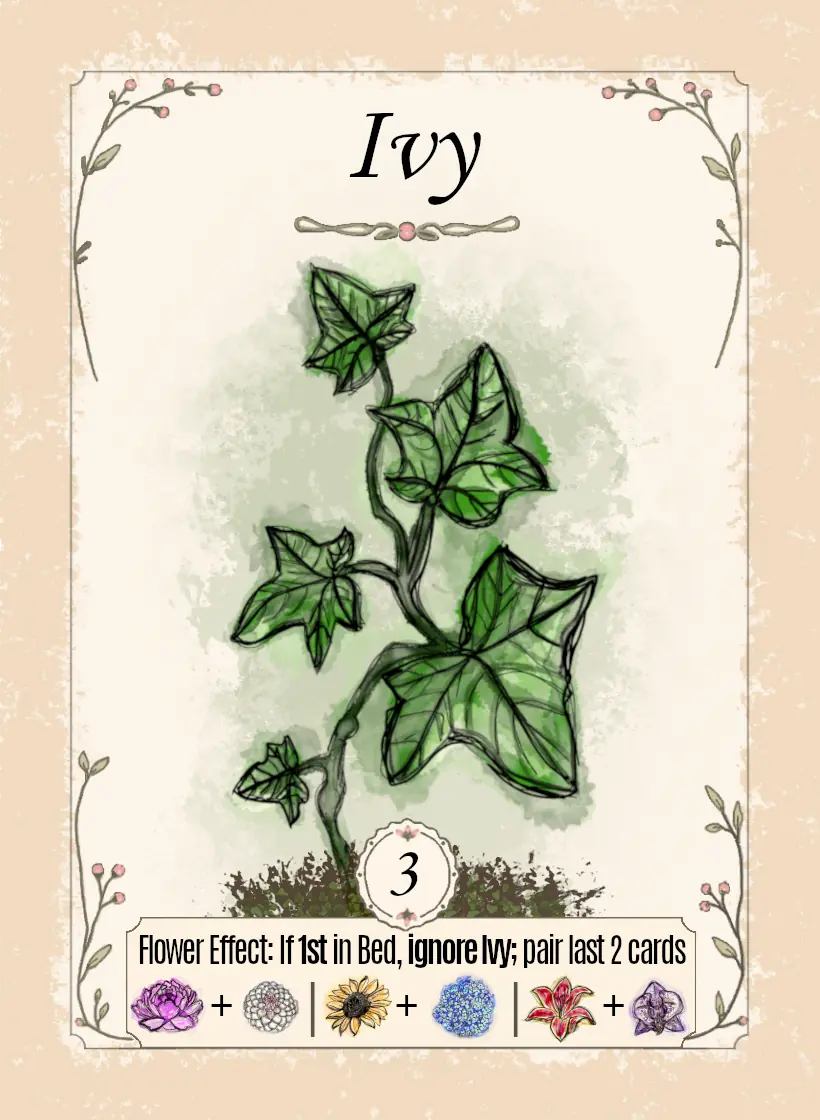
Ivy
Card text: Flower Effect: If 1st in Bed, ignore Ivy; pair last 2 cards.
Complete rule: When Ivy starts a new Bed, ignore Ivy and all of its pairing icons when checking that Bed. The second and third Flowers need only form a legal pair with each other. If Ivy is played second or third, it behaves as normal Ivy and the completed Bed must match a printed legal arrangement.
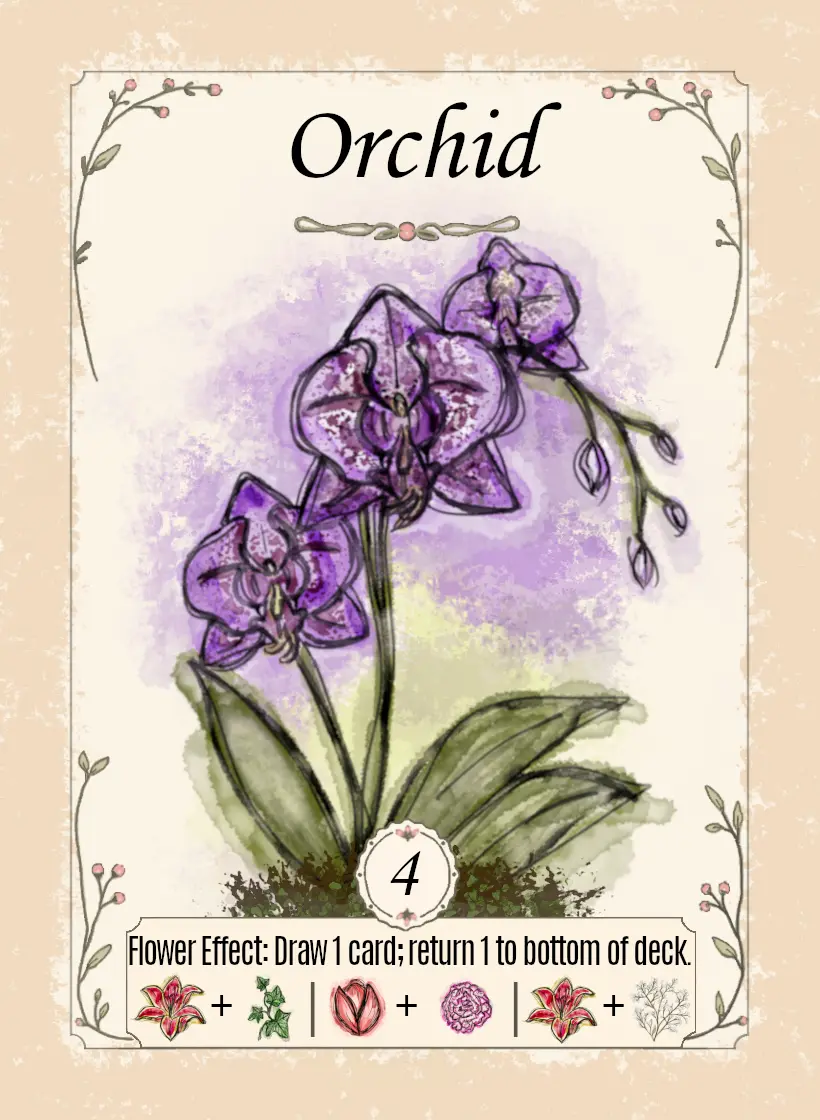
Orchid
Card text: Flower Effect: Draw 1 card; return 1 to bottom of deck.
Complete rule: After playing Orchid face-up legally, draw the top Flower card. Then choose any 1 Flower card from your hand—including the card just drawn—and place it on the bottom of the Flower Deck. This is not a discard.
Flower compatibility & substitutions
Use this section during play when you need a fast answer to “What works with this card?” Each Base Flower lists every Flower type shown in its three printed pair boxes, followed by the exact legal 3-card combinations. Wildflowers also show which Base Flower they may substitute for.
Rose
Compatible with:
Printed legal pairs:
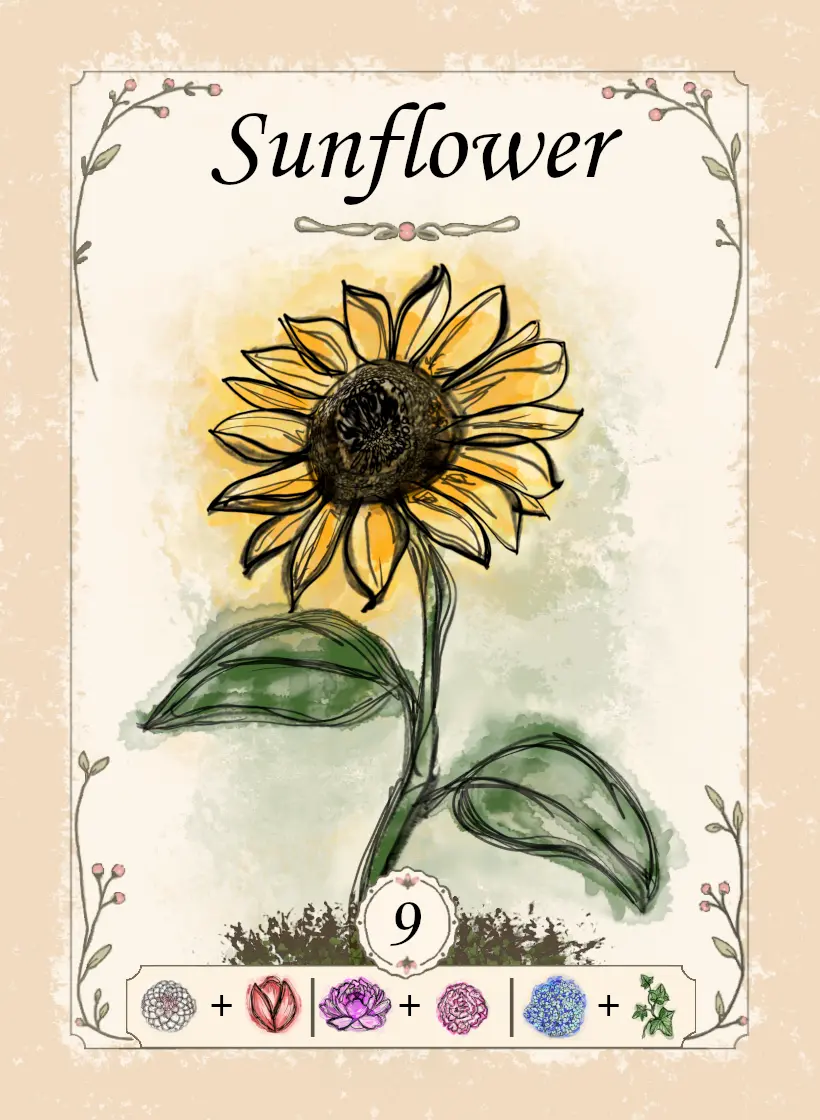
Sunflower
Compatible with:
Printed legal pairs:
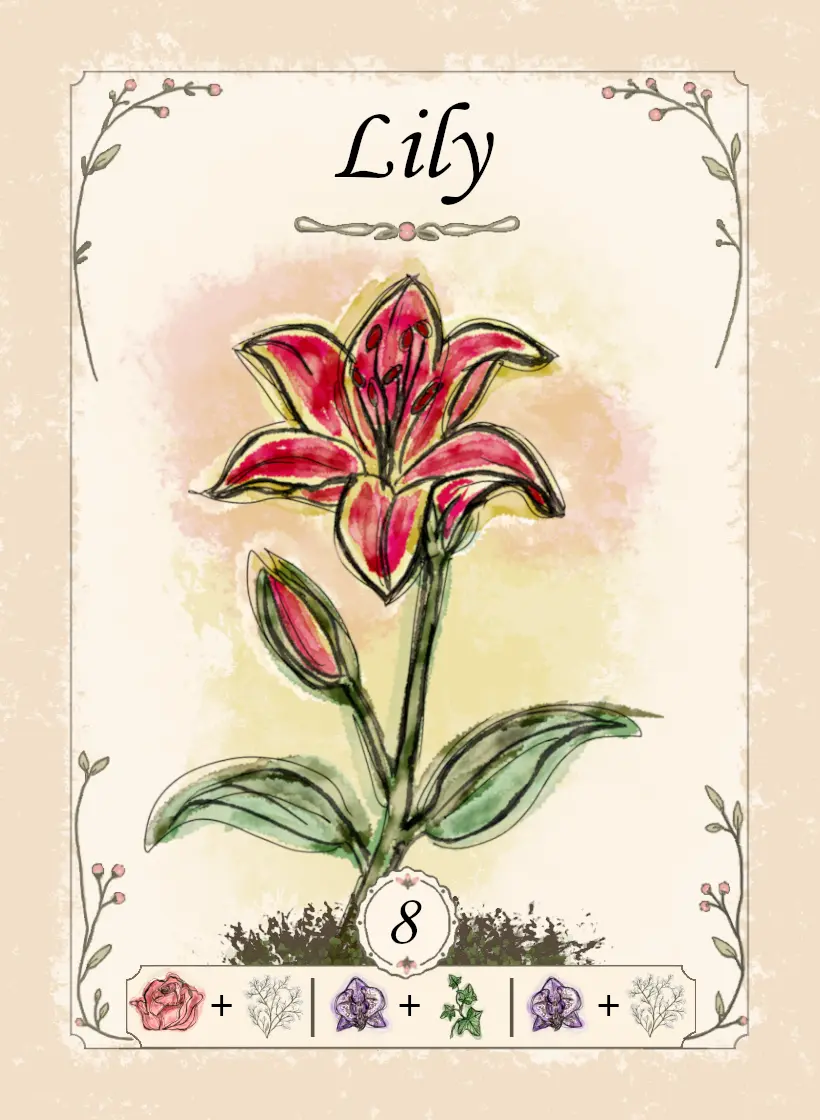
Lily
Compatible with:
Printed legal pairs:
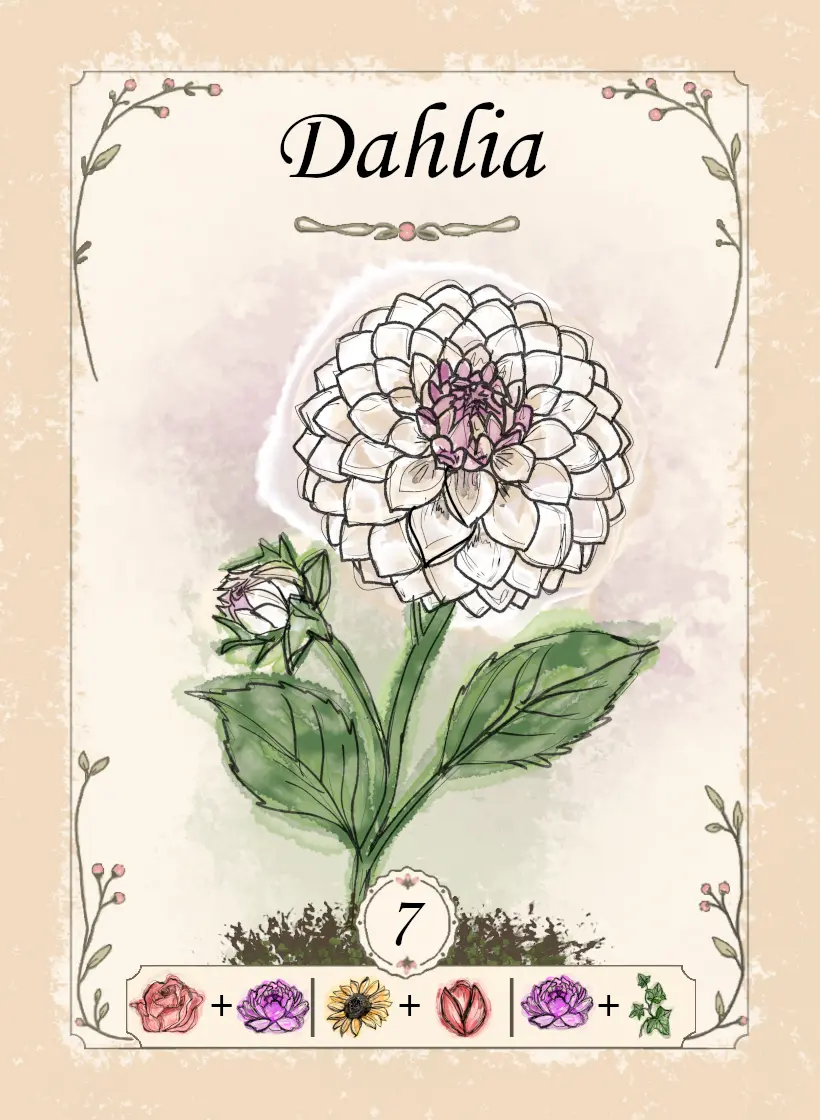
Dahlia
Compatible with:
Printed legal pairs:
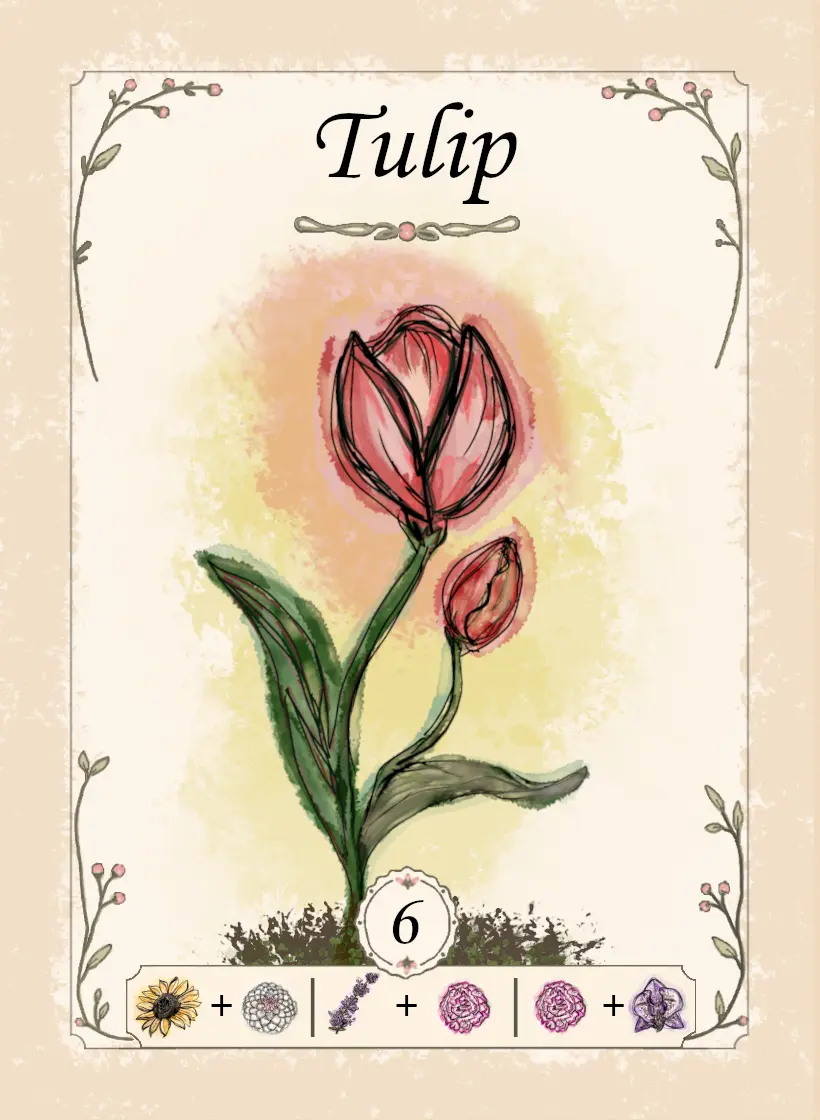
Tulip
Compatible with:
Printed legal pairs:
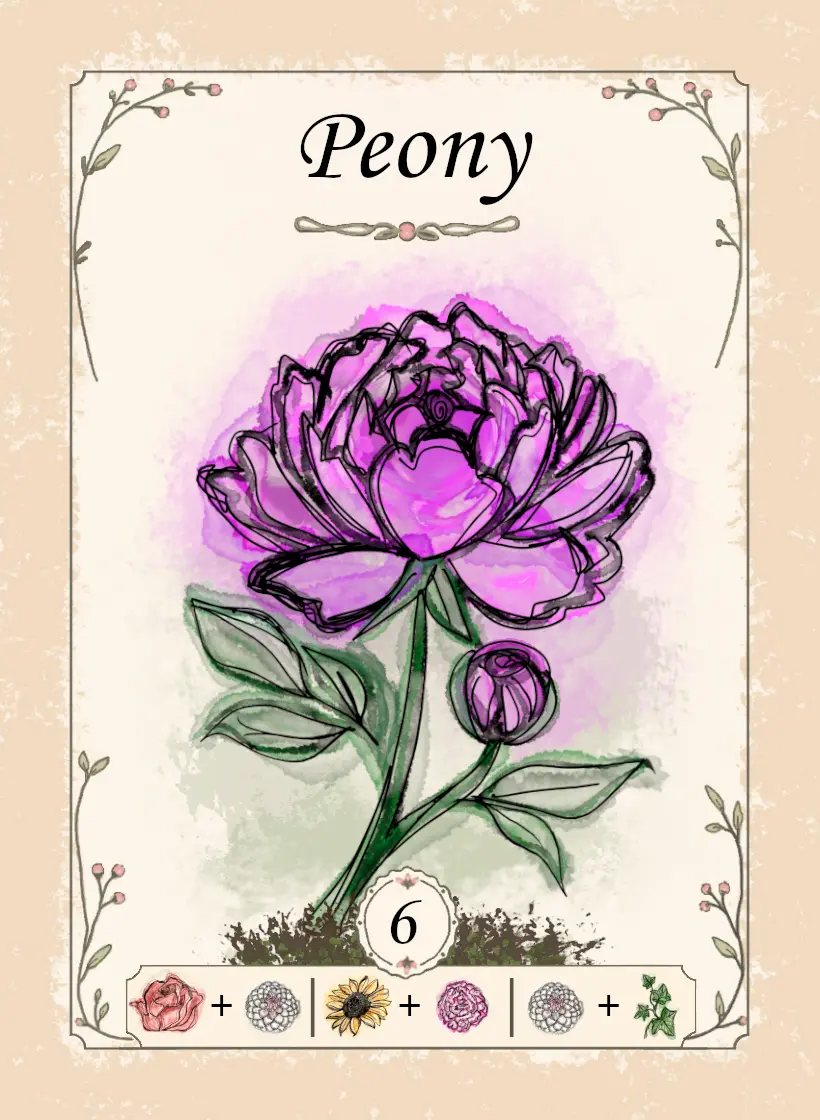
Peony
Compatible with:
Printed legal pairs:
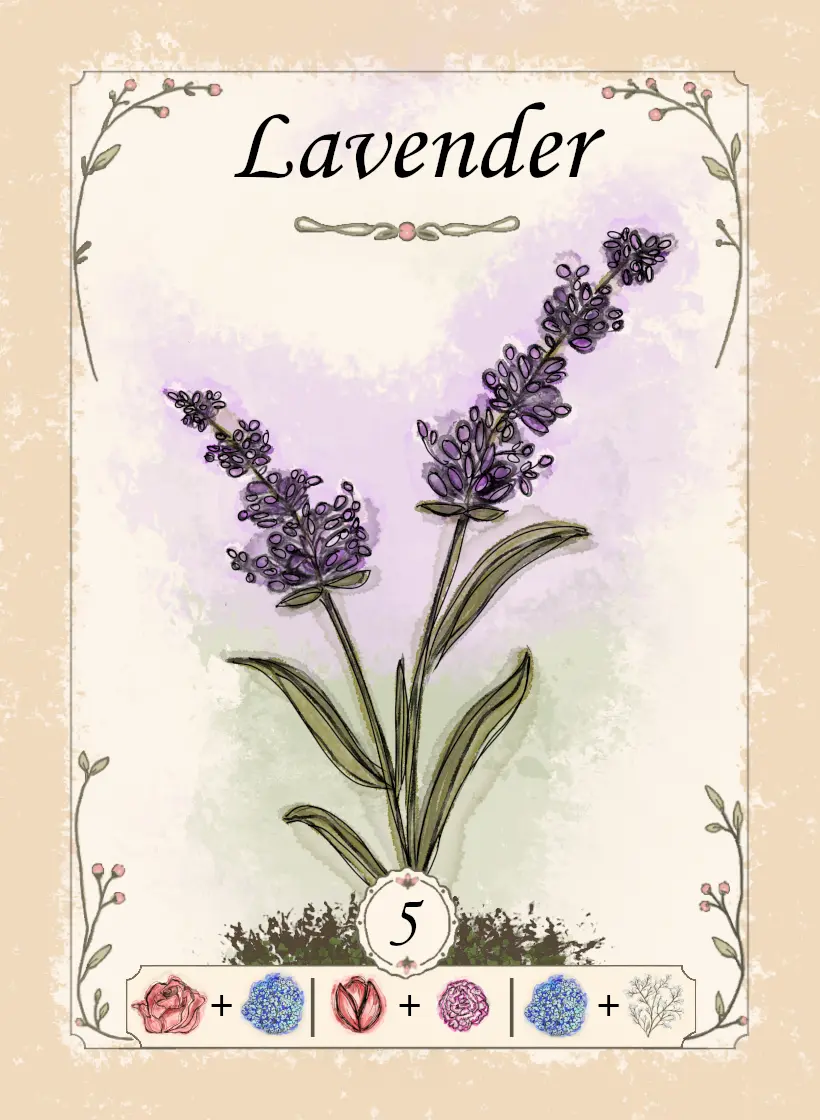
Lavender
Compatible with:
Printed legal pairs:
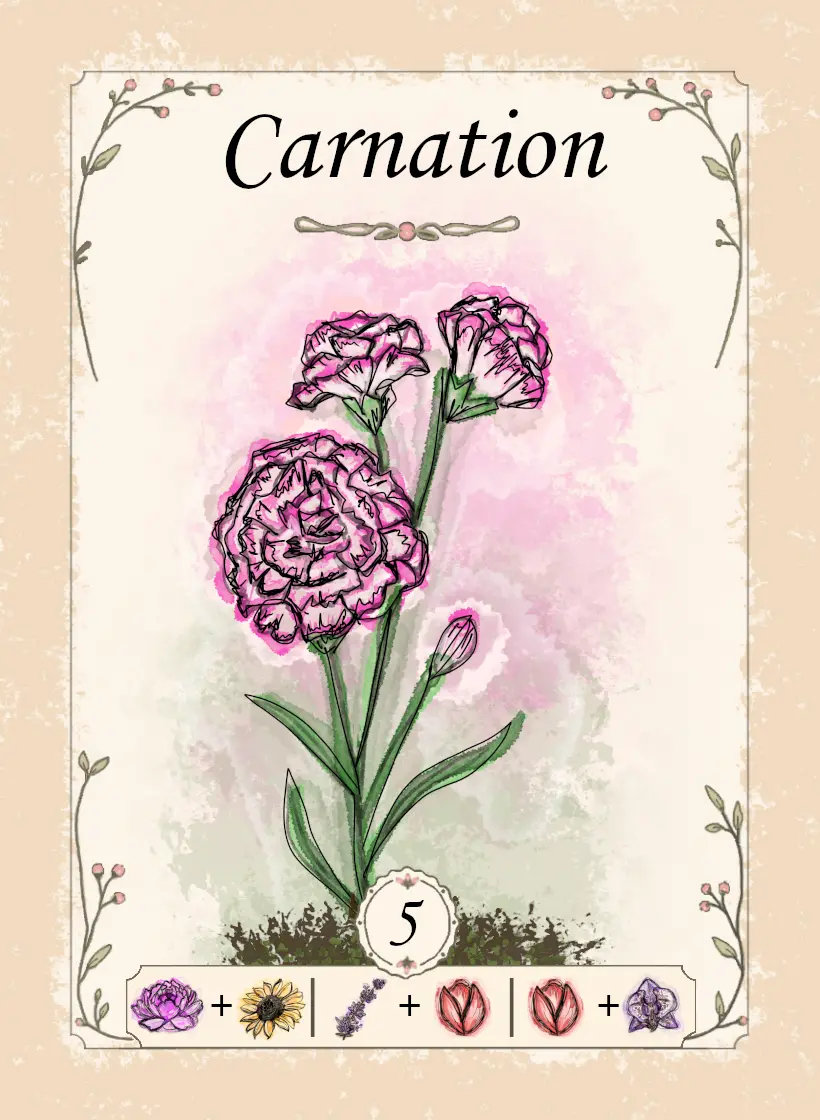
Carnation
Compatible with:
Printed legal pairs:
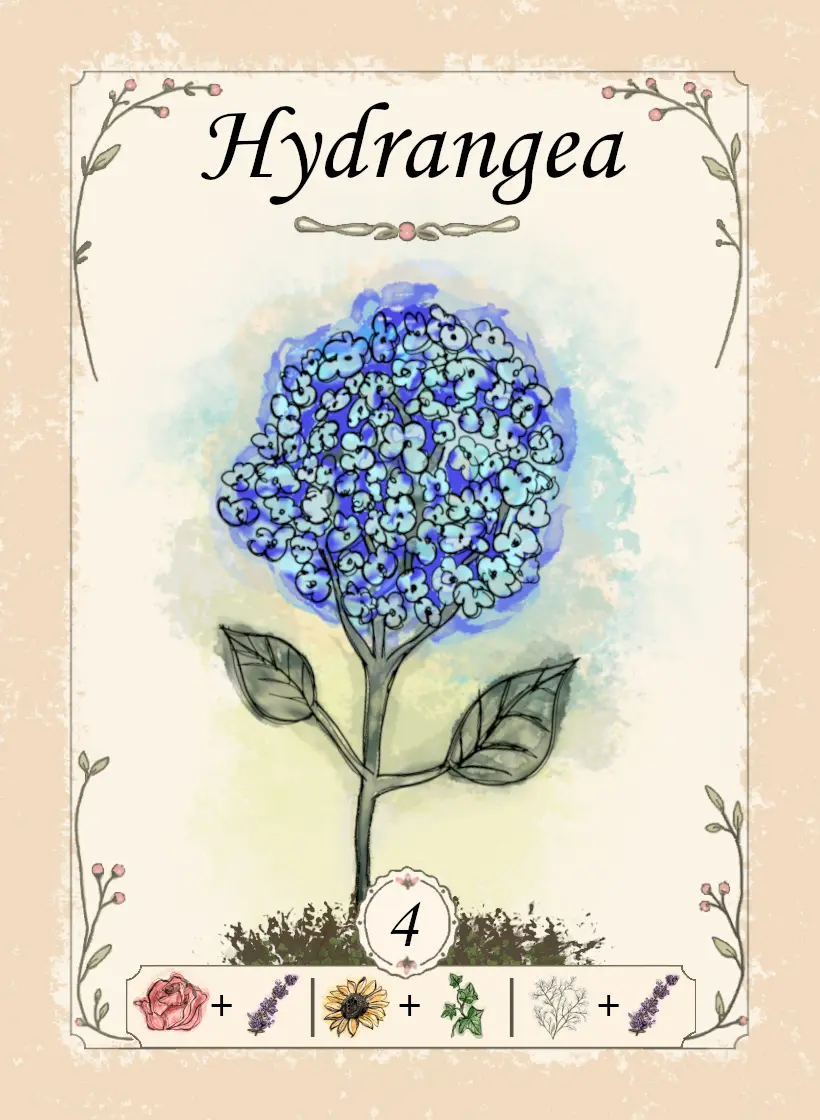
Hydrangea
Compatible with:
Printed legal pairs:
Orchid
Compatible with:
Printed legal pairs:
Ivy
Compatible with:
Printed legal pairs:
Baby’s Breath
Compatible with:
Printed legal pairs:
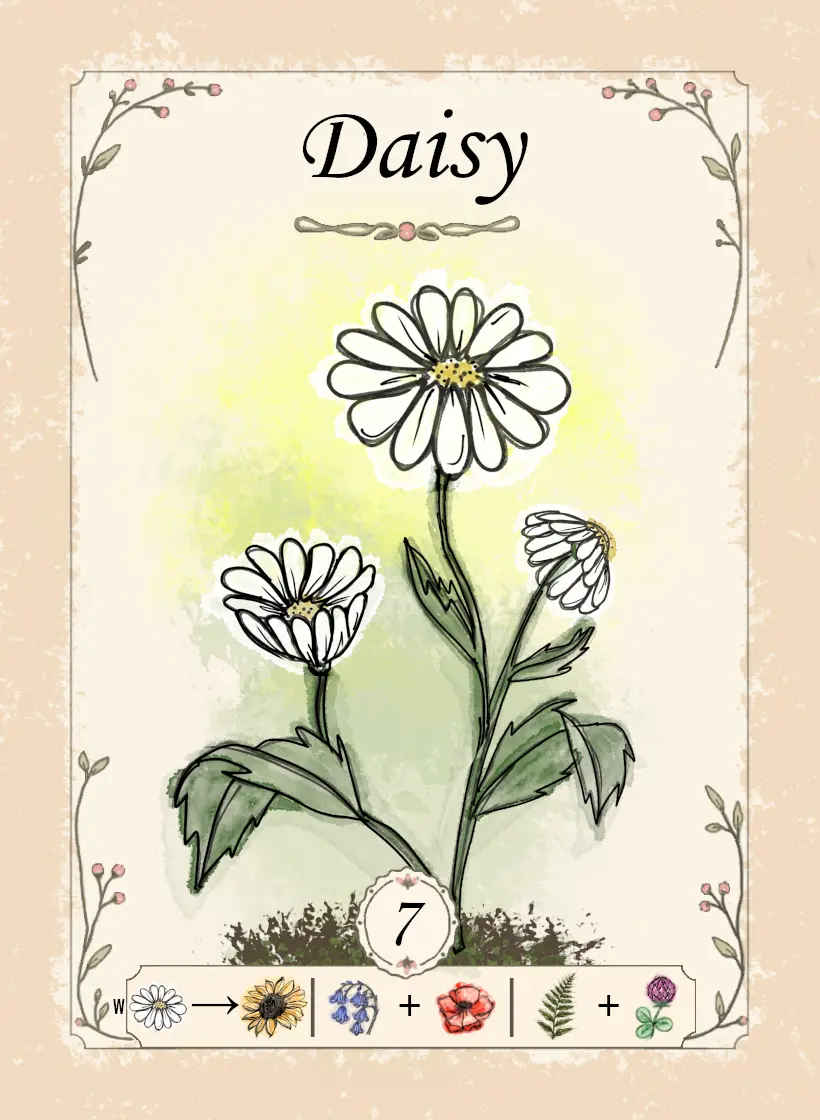
Daisy
Substitutes for: Sunflower
Compatible with as itself:
Printed Wildflower pairs:
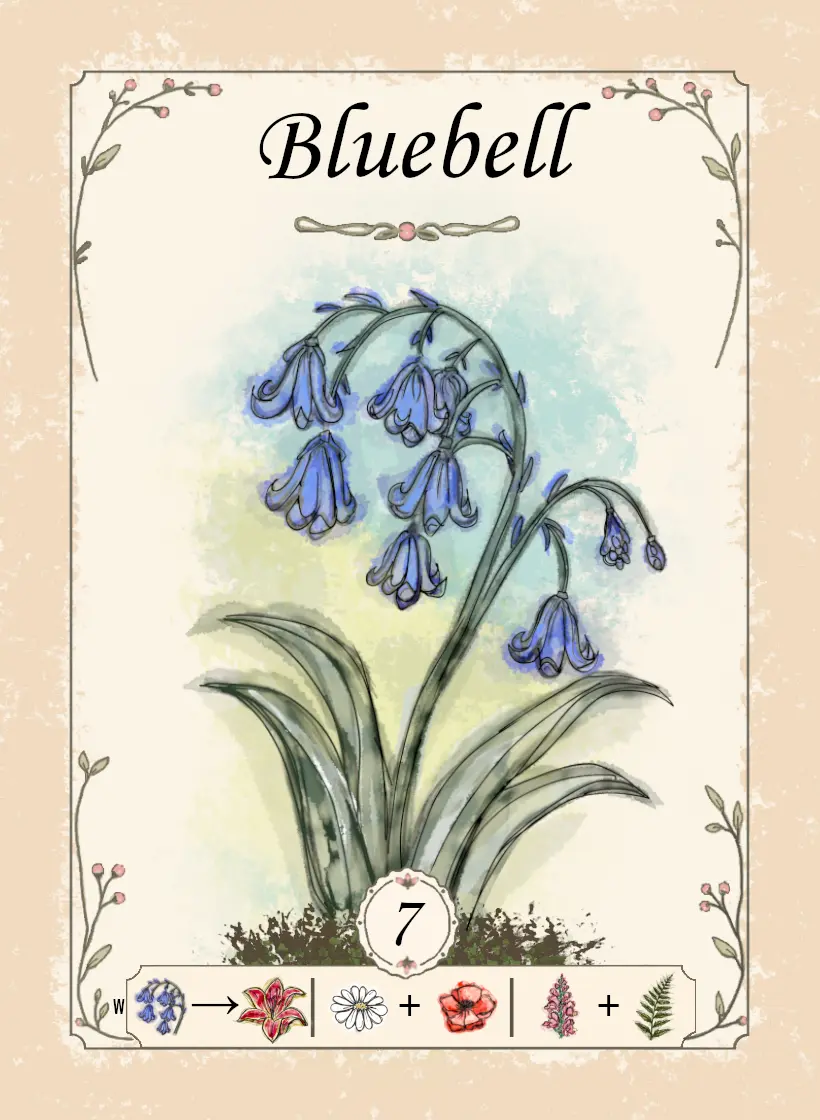
Bluebell
Substitutes for: Lily
Compatible with as itself:
Printed Wildflower pairs:
Poppy
Substitutes for: Rose
Compatible with as itself:
Printed Wildflower pairs:
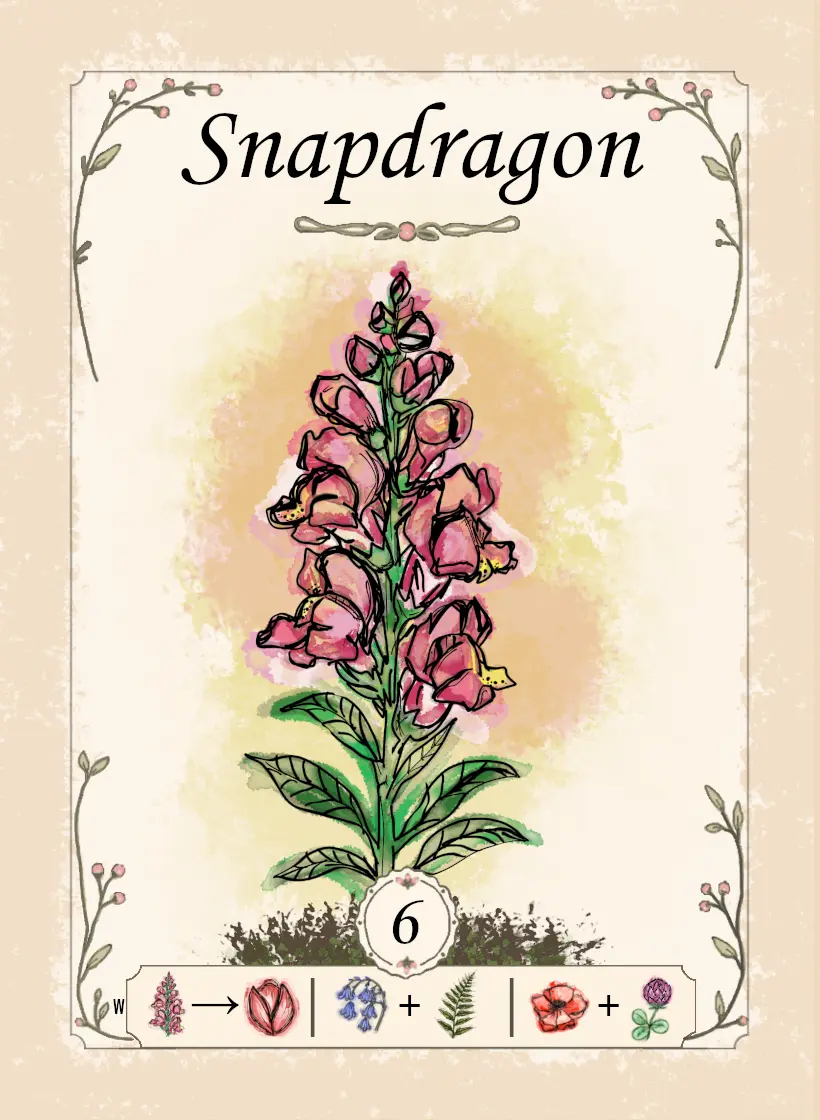
Snapdragon
Substitutes for: Tulip
Compatible with as itself:
Printed Wildflower pairs:
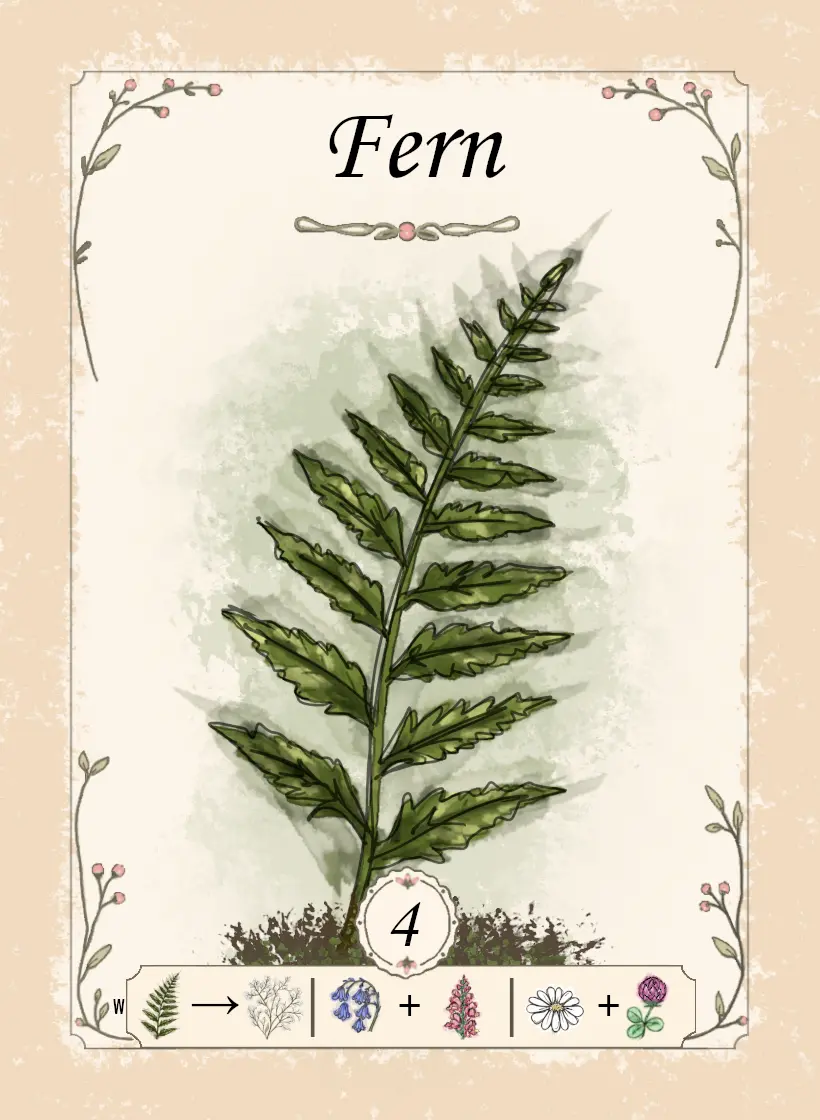
Fern
Substitutes for: Baby’s Breath
Compatible with as itself:
Printed Wildflower pairs:
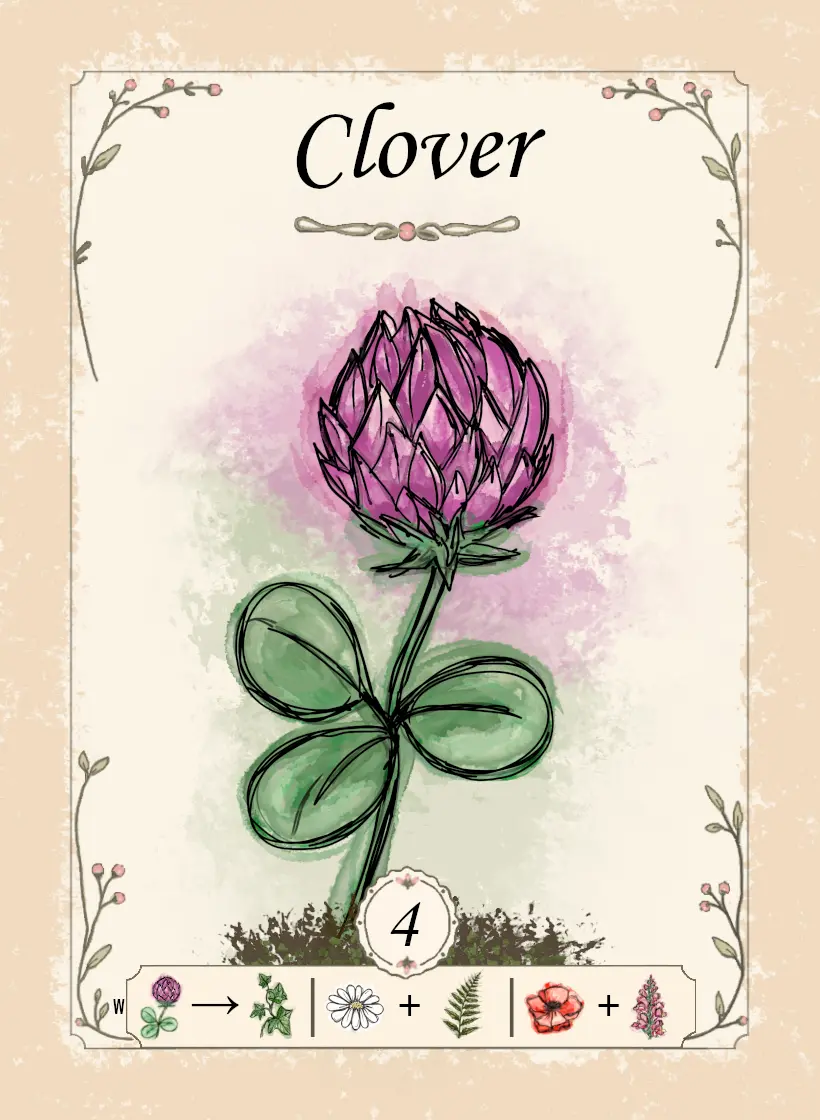
Clover
Substitutes for: Ivy
Compatible with as itself:
Printed Wildflower pairs:
Wildflower substitution chart
Compost
What Compost does
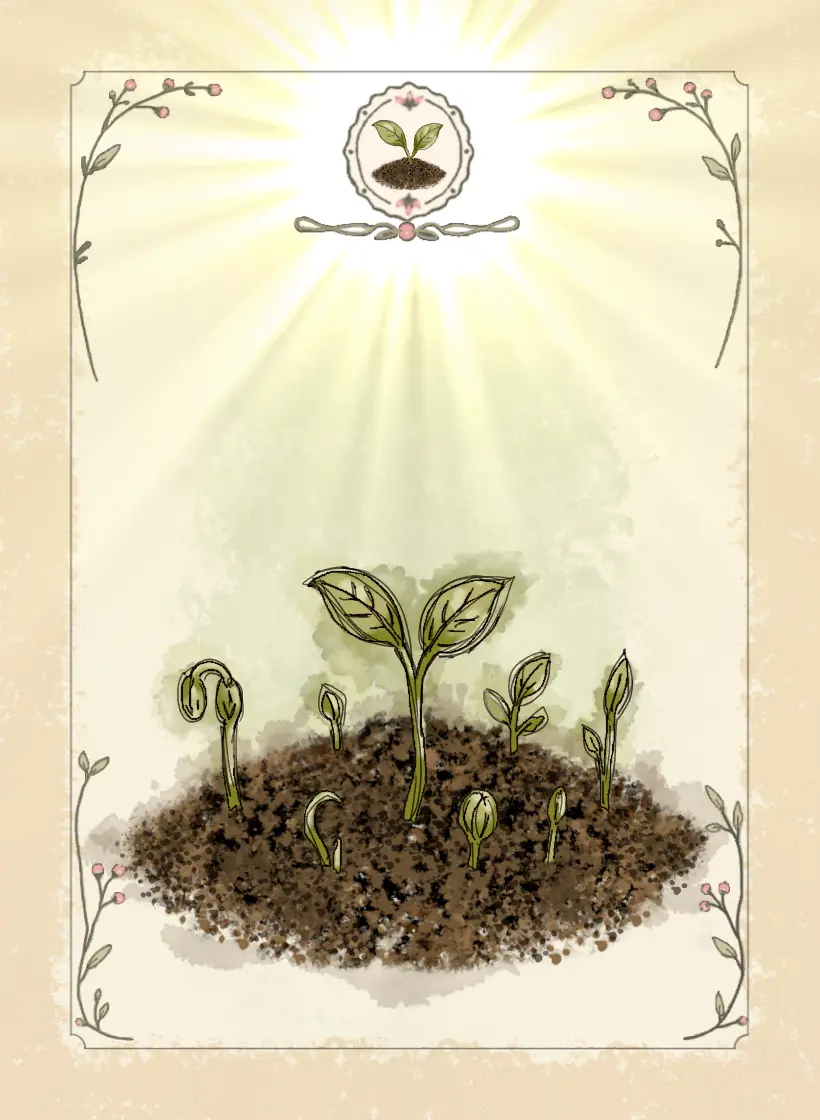
- Compost has no Flower type.
- Compost does not block.
- Compost does not count as a Flower.
- Compost scores 1 point if Harvested.
- Compost may fill empty spots in a Bouquet.
Important restriction
Three Compost cards are never legal. A completed Flower Bed must have at least 1 face-up Flower.
Blocking & Favor
Blocking
An opponent’s face-up Flower blocks that same Flower type for you. Your own Flower Beds do not block you. Blocking lasts while that Flower stays in a Flower Bed.
- Harvested Bouquets do not block.
- Compost does not block.
- Pigweed does not block.
- Cards do not block from hand, discard, Harvested Area, Flower Deck, or Parlay Deck.
Favor token
Place your Favor token on 1 opponent’s Flower Bed. The Flower types currently shown in that Bed determine what your Favor covers.
- When Favor is placed, note every face-up Flower type currently in that Bed.
- You may ignore blocking from those Flower types everywhere on the table—even if the same type is growing in another Bed.
- The covered types are frozen when Favor is placed. Flowers added to the favored Bed later are not covered.
- The exception lasts until the favored Bed is Harvested. Its owner then keeps the token.
Turn structure
If you have a Parlay card, you may play 1 Parlay card first. Then follow the normal turn rules below.
If you can Harvest
You must Harvest. Move 1 completed legal Flower Bed to your Harvested Area. It is now a Bouquet.
If you cannot Harvest
Draw 1 Flower card, then play 1 Flower card into a Flower Bed.
When you Harvest
The Bouquet stops blocking opponents. Keep any Favor tokens on that Bouquet. Return any Substitute token for reuse. If it has a Wildflower, draw 1 Parlay card.
Wildflowers
Wildflowers are designed for 5–6 player games, but may be added to any player count. Each Wildflower card shows both the Base Flower it can replace and its own Wildflower pairings.
| Wildflower | Copies | Points | May substitute for |
|---|---|---|---|
| Daisy | 3 | 7 | Sunflower |
| Bluebell | 3 | 7 | Lily |
| Poppy | 3 | 6 | Rose |
| Snapdragon | 3 | 6 | Tulip |
| Fern | 3 | 4 | Baby’s Breath |
| Clover | 3 | 4 | Ivy |
Played as itself
A Wildflower played as itself works like a normal Flower. It blocks and is blocked like that Wildflower type.
Played as a substitute
- Place your Substitute token on it.
- It counts as the shown Base Flower for legality.
- It keeps its own printed point value.
- It does not block and is not blocked.
- You may have only 1 active substitute at a time.
Parlay cards
Parlay cards are used with Wildflowers. There are 12 total: 6 Cultivate cards that help your own garden and 6 Weed cards that interfere with opponents.
Drawing Parlay cards
When you Harvest a Bouquet, draw 1 Parlay card for each Wildflower in it. A Wildflower used as a substitute still counts as a Wildflower. Do not draw Parlay cards during Final Harvest.
Playing Parlay cards
On your turn, before your normal action, you may play 1 Parlay card. If a Parlay card breaks a normal rule, follow the card.
Weed targeting
When a Weed says “opponent,” choose an opponent with the same number or more Harvested Bouquets than you. If nobody qualifies, you cannot play that Weed.
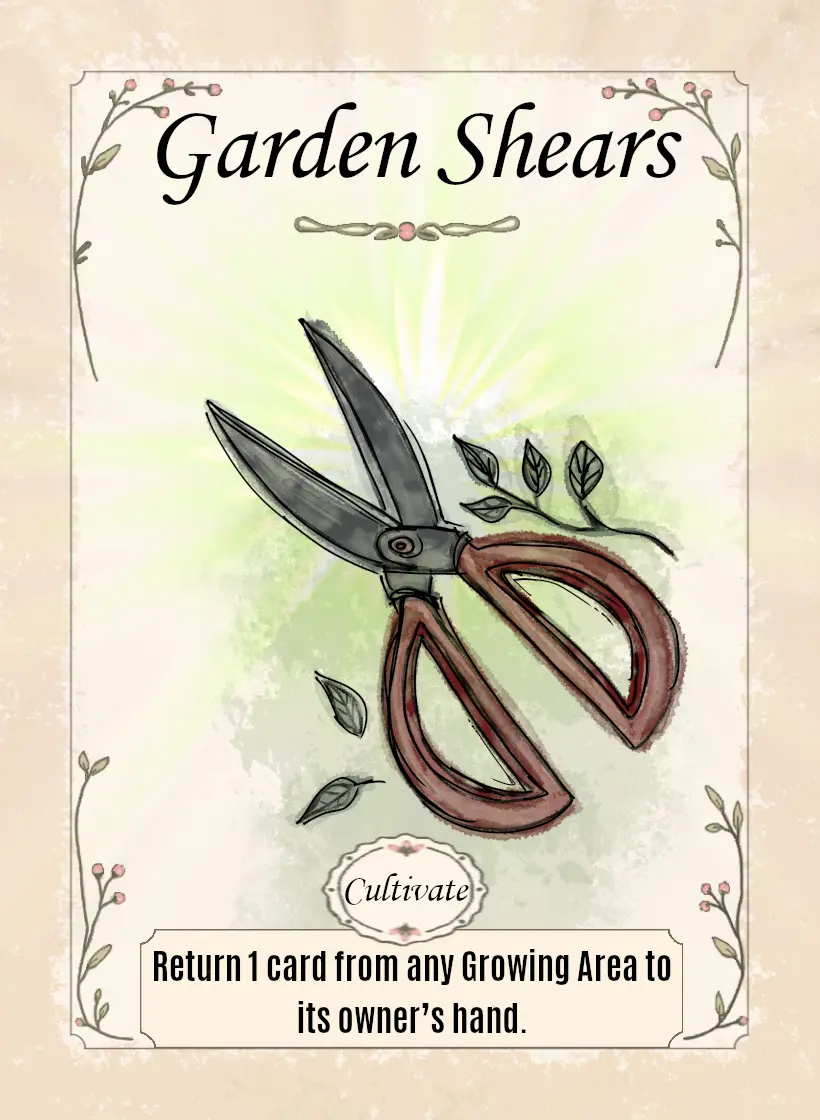
Garden Shears
Card text: Return 1 card from any Growing Area to its owner’s hand.
Complete rule: Choose any unharvested card in any player’s Growing Area, including your own, and return it to the appropriate owner’s hand. Face-up Flowers, face-down Compost, Green Thumb, and Pigweed may be returned. A returned substitute releases its Substitute token.
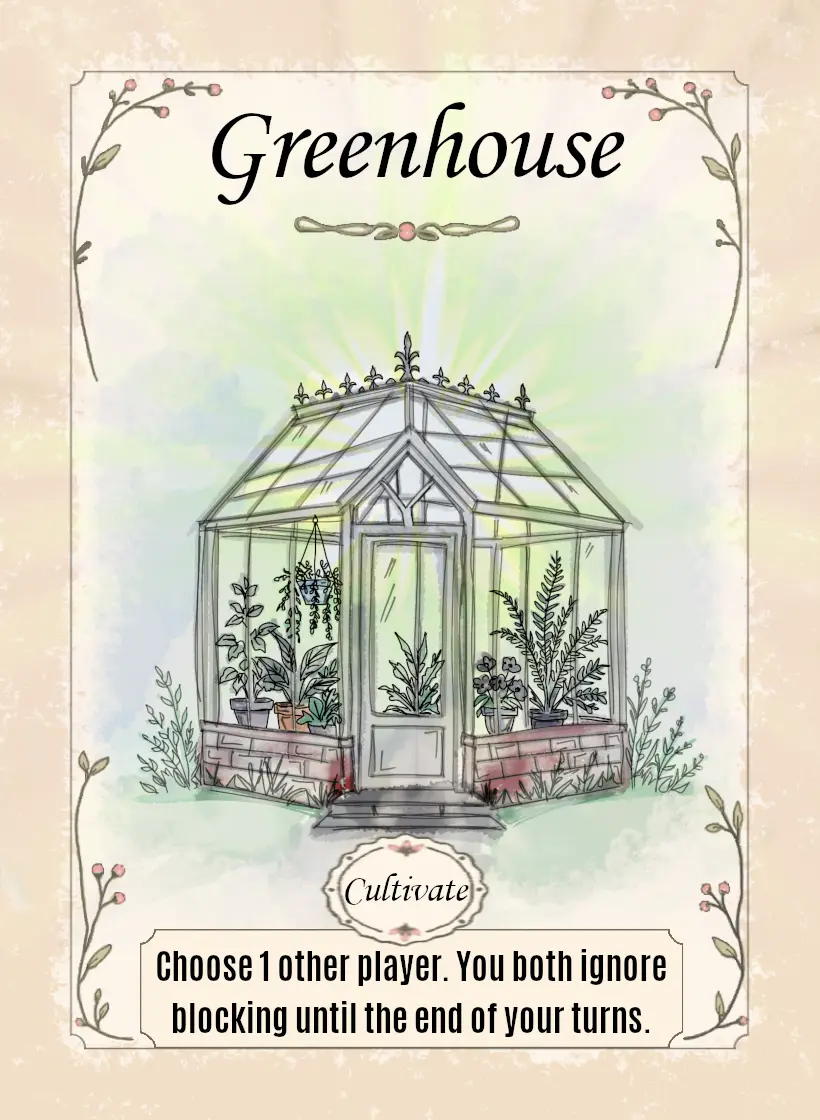
Greenhouse
Card text: Choose 1 other player. You both ignore blocking until the end of your turns.
Complete rule: You ignore all Flower blocking for the rest of your current turn. The chosen player ignores blocking during their next turn. All Flower Beds must still be legal.
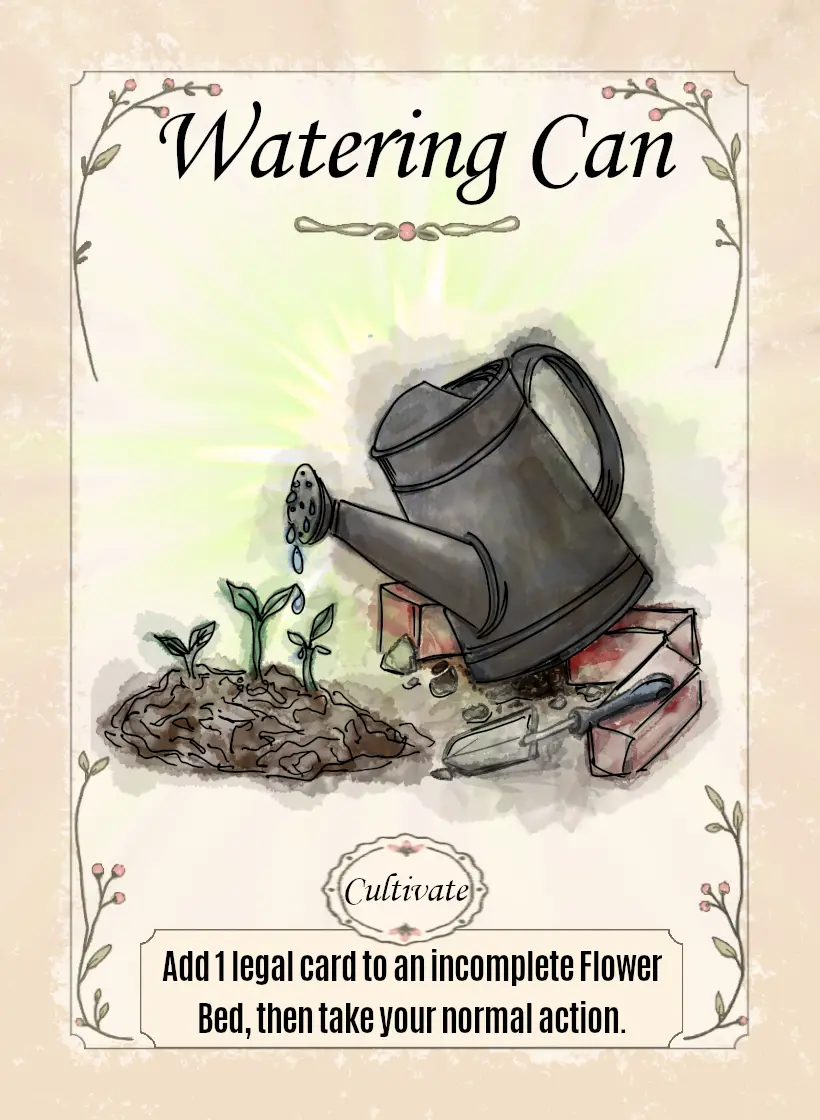
Watering Can
Card text: Add 1 legal card to an incomplete Flower Bed, then take your normal action.
Complete rule: Play 1 card from your hand into one of your incomplete Beds as a legal Flower, substitute, or Compost. Then continue to your normal action.
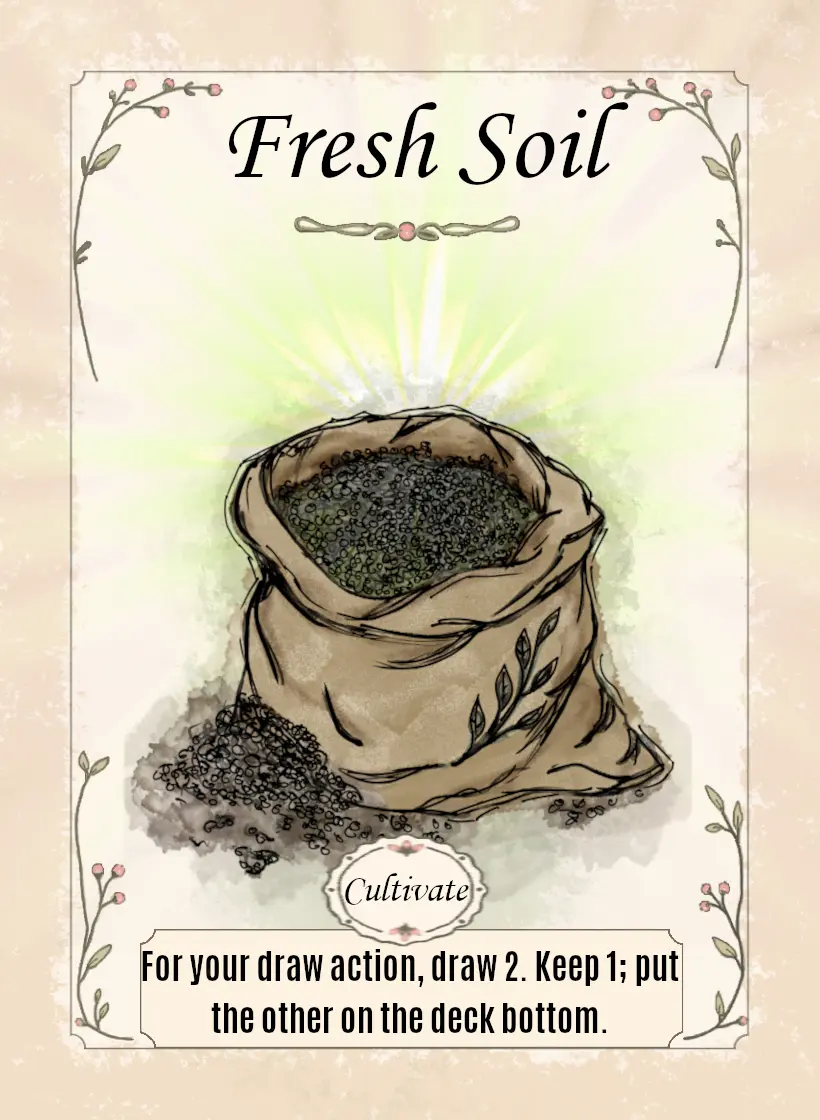
Fresh Soil
Card text: For your draw action, draw 2. Keep 1; put the other on the deck bottom.
Complete rule: Play this before choosing to draw. Draw the top 2 Flower cards, keep 1, and place the other on the bottom of the Flower Deck. If only 1 card remains, keep that card.
Green Thumb
Card text: Place in any unfinished Bed. Acts as any Flower. Scores same as the lowest card.
Complete rule: Place Green Thumb directly into one of your unfinished Beds. It fills a card space and acts as whichever Flower is needed to make that Bed legal. When Harvested, it scores the same value as the lowest other card in that Bouquet.
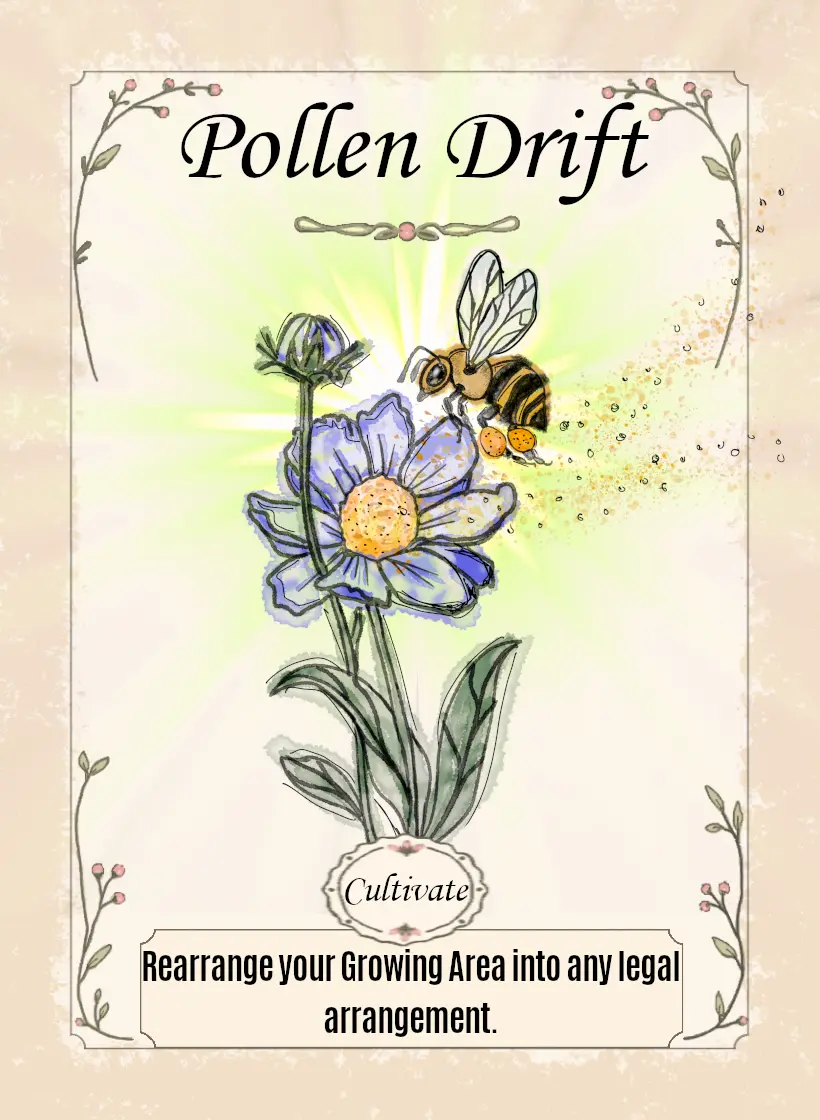
Pollen Drift
Card text: Rearrange your Growing Area into any legal arrangement.
Complete rule: Move cards between your two Flower Beds in any way you choose. When finished, both Beds must be legal for their current number of cards. Move any Substitute token with its card.
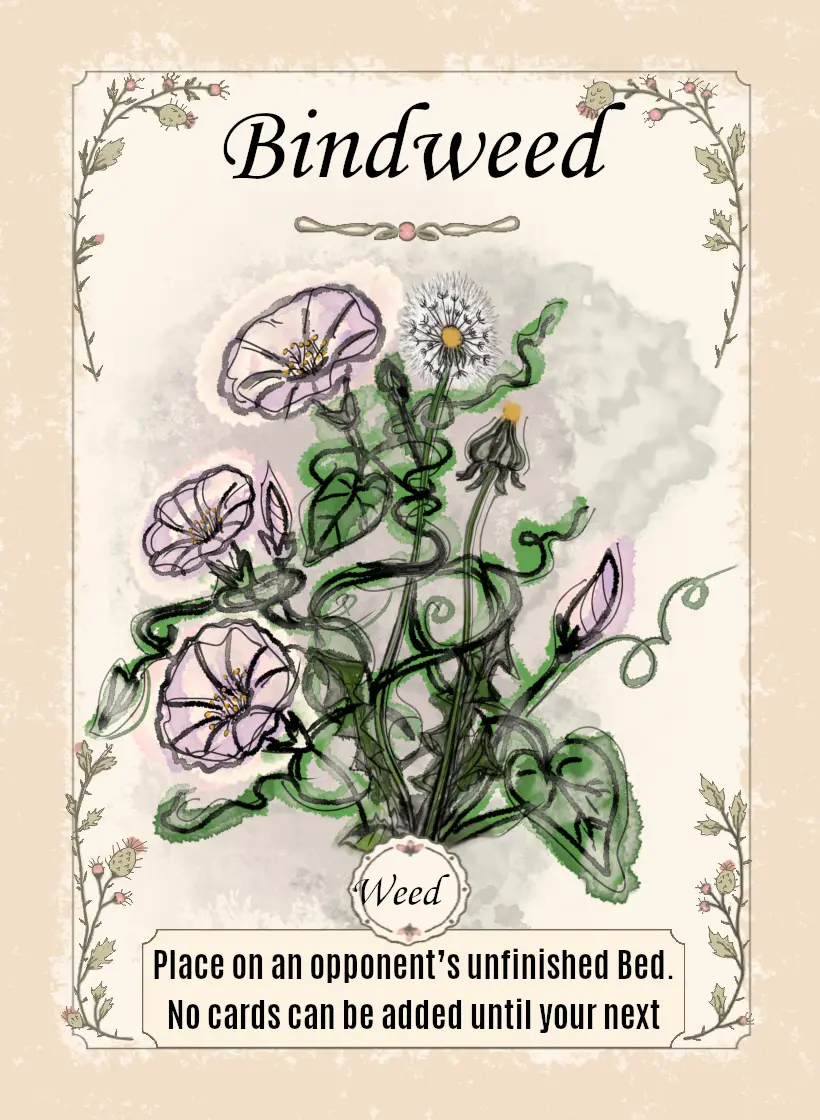
Bindweed
Card text: Place on an opponent’s unfinished Bed. No cards may be added until your next turn.
Complete rule: Choose an eligible opponent and mark one unfinished Bed with Bindweed. No cards may be added to that Bed until the beginning of your next turn. Existing cards remain in place.
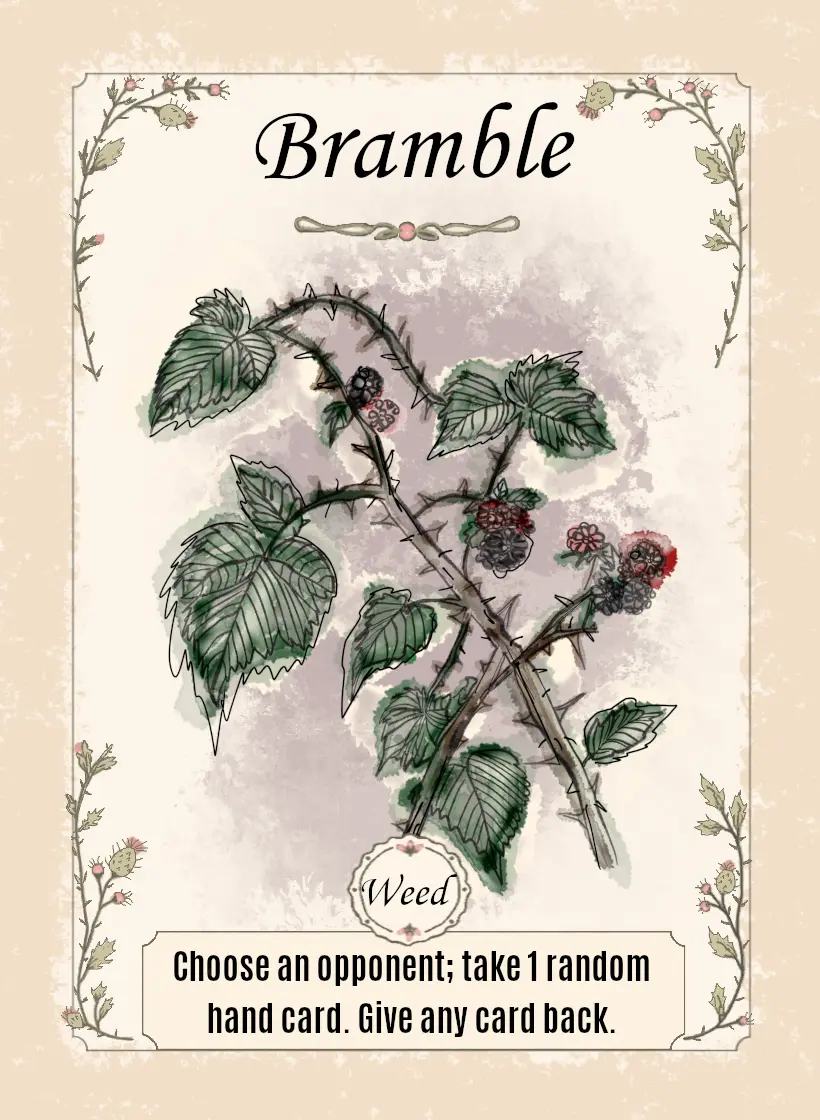
Bramble
Card text: Choose an opponent; take 1 random hand card. Give any card back.
Complete rule: Choose an eligible opponent and take 1 random card from their hand. Then choose any 1 card from your own hand and give it to that opponent.
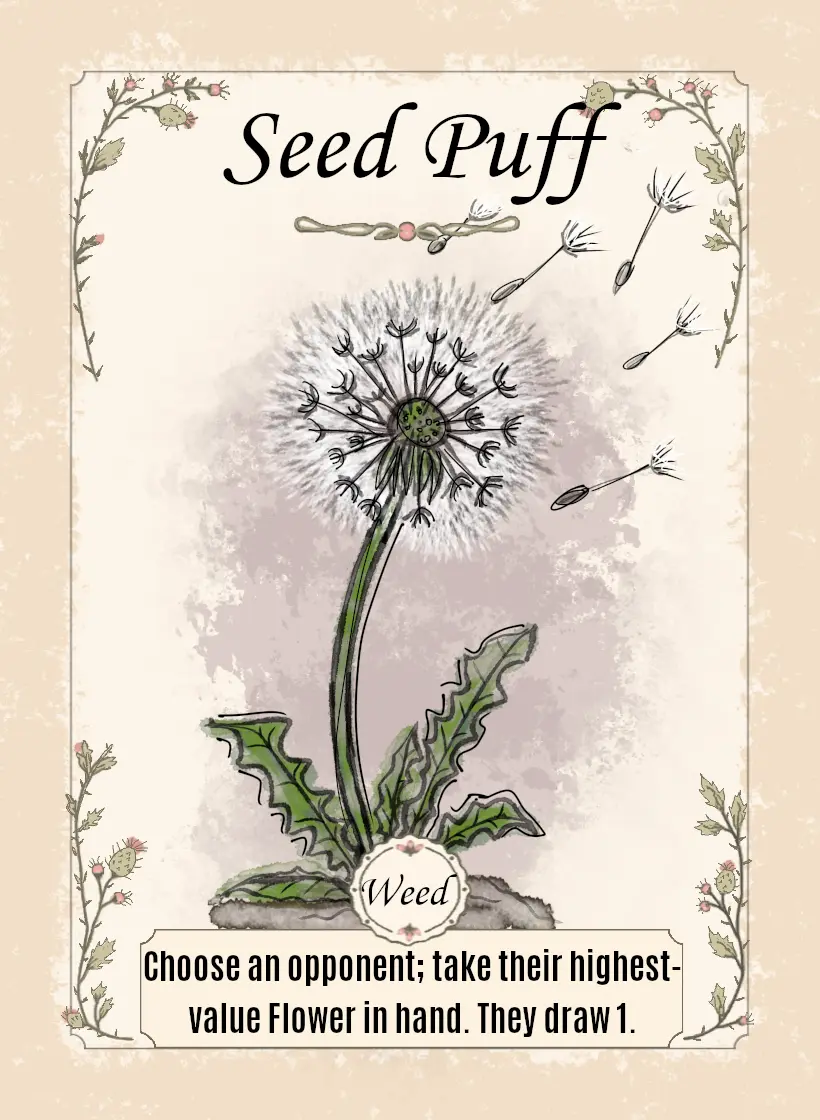
Seed Puff
Card text: Choose an opponent; take their highest-value Flower in hand. They draw 1.
Complete rule: Choose an eligible opponent and take their highest-value Flower card from hand. If more than one is tied for highest, randomly choose among them. That opponent then draws 1 Flower card, if possible.
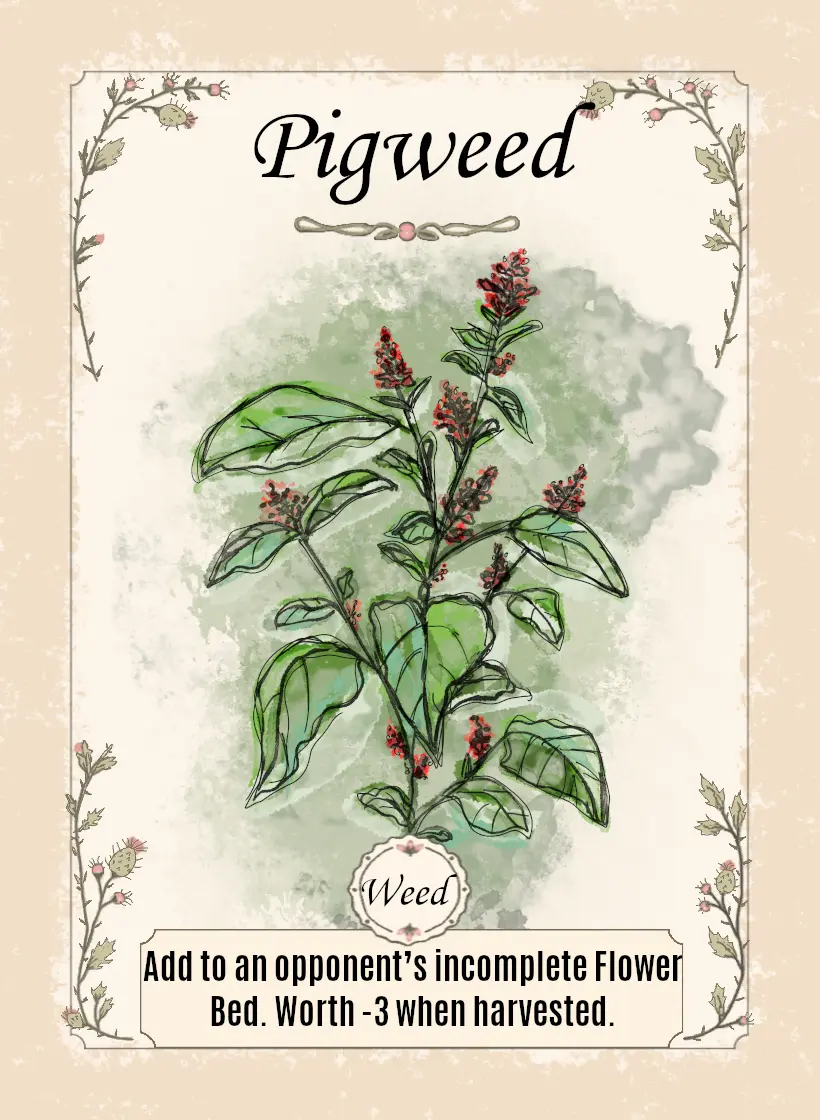
Pigweed
Card text: Add to an opponent’s incomplete Flower Bed. Worth −3 when harvested.
Complete rule: Choose an eligible opponent and place Pigweed into one of their incomplete Beds. It fills 1 card space, has no Flower type, does not block, and is worth −3 points when that Bed is Harvested. It is not Compost.
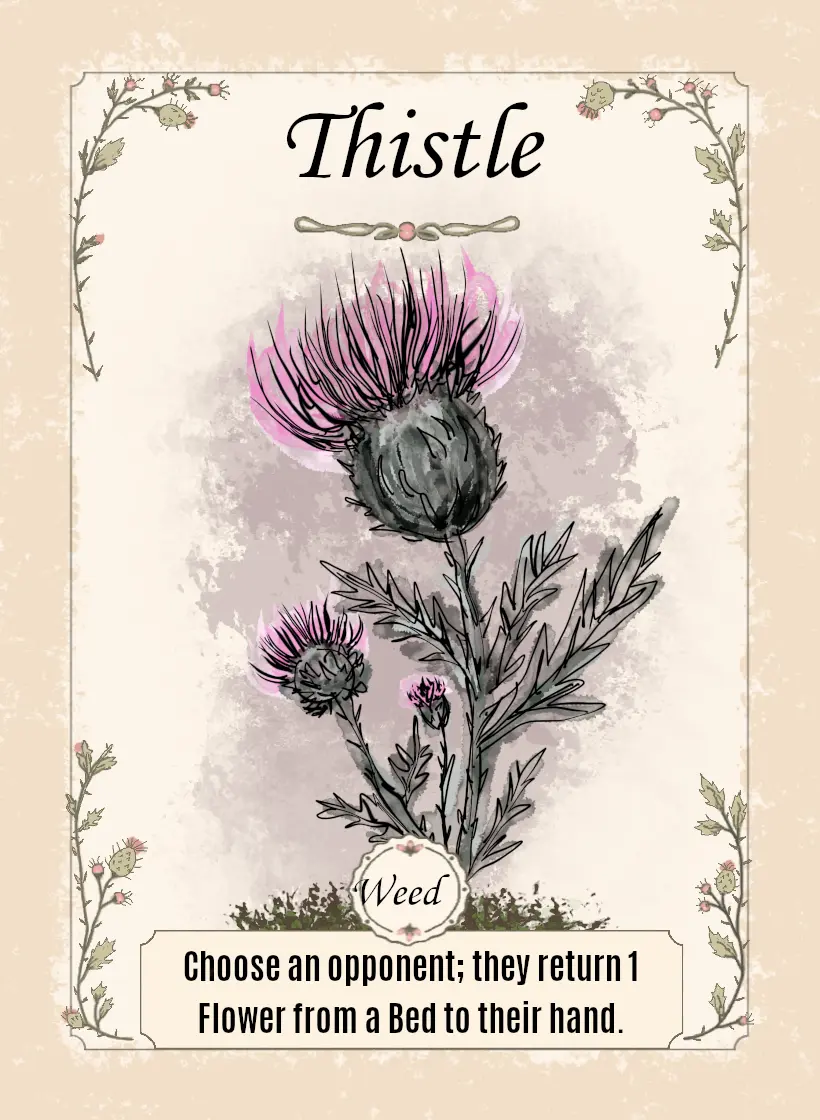
Thistle
Card text: Choose an opponent; they return 1 Flower from a Bed to their hand.
Complete rule: Choose an eligible opponent. They choose 1 face-up Flower from one of their unharvested Beds and return it to their hand. If it was being used as a substitute, its Substitute token becomes available again.
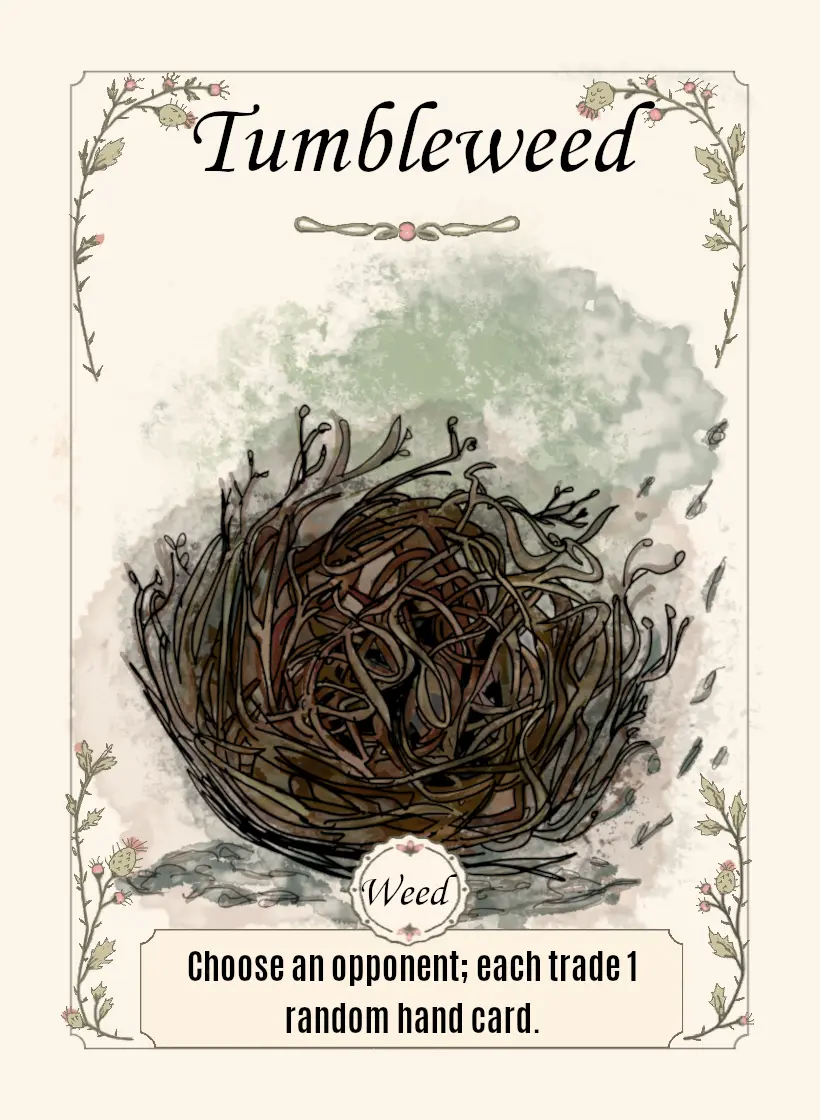
Tumbleweed
Card text: Choose an opponent; each trade 1 random hand card.
Complete rule: Choose an eligible opponent. Randomly choose 1 card from each of your hands and exchange them. If either player has no cards, the exchange cannot happen.
Season’s End
Season’s End begins when the Flower Deck is empty. Finish the current turn. Then players who still need one more turn take a Final Play so everyone has had the same number of turns.
Final Play
Only players who still need a turn this round take a Final Play. You may play 1 Parlay card first, then choose 1 action: play 1 card, Harvest 1 Bouquet, or pass. No Flower cards are drawn during Final Play. If a Parlay card requires drawing Flower cards, that part does not happen.
If you Harvest a Wildflower Bouquet during Final Play, you may still draw 1 Parlay card. That card cannot be played during Final Harvest, but may score as an unused Parlay card.
Final Harvest
After Final Play, each player may Harvest 1 completed Bouquet, or pass. During Final Harvest: no Parlay cards may be played, no Flower cards are drawn, and no Parlay cards are drawn.
Then score
Go through Sprout, Wilt, Awards, Bouquets, and Favor & Parlay in that order.
Scoring
Keep Bouquets together until Awards are scored. Score in this order:
Awards
There are 4 double-sided Award cards, giving you 8 possible Award sides. Each side has one 4-point Award and two 3-point Awards.
2–4 players
Reveal 1 Award card side and use all 3 Awards shown.
5–6 players
Reveal 2 Award card sides. Use all 3 Awards from one side and 2 Awards from the second side for a total of 5 active Awards.
Ties
If players tie for an Award, every tied player receives the full Award value. Do not split the points.
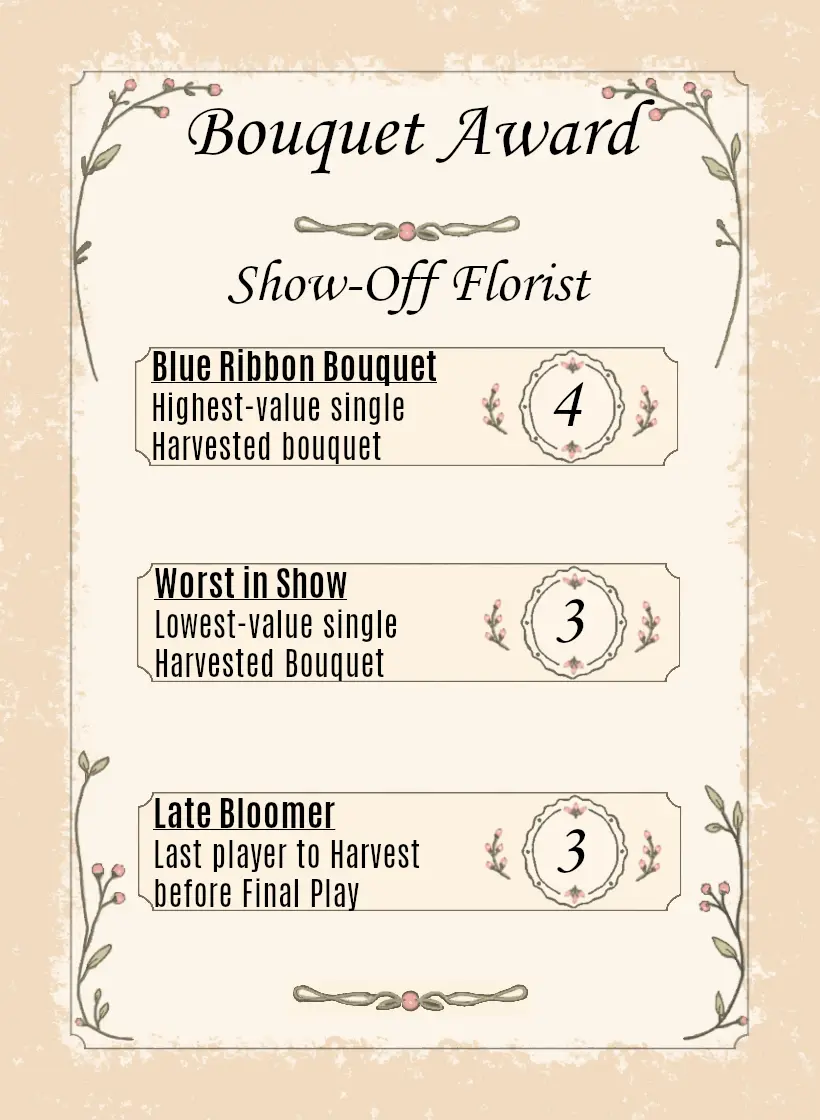
Show-Off Florist
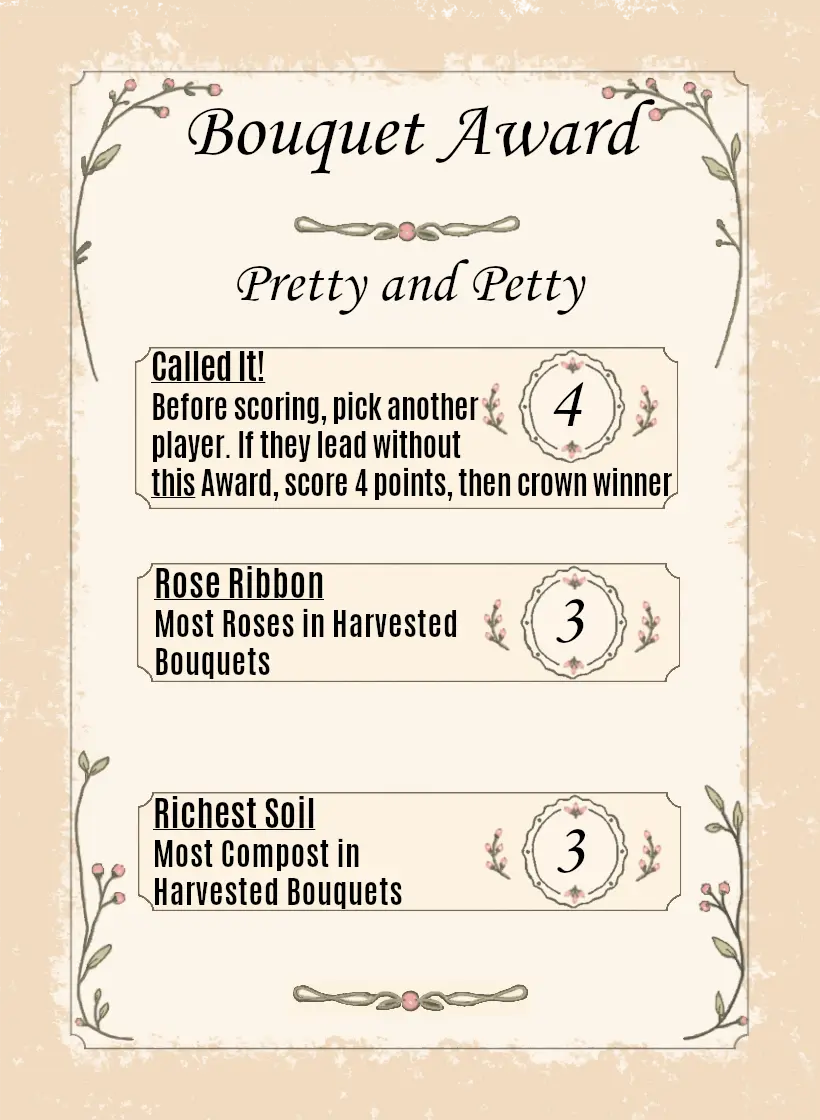
Pretty & Petty
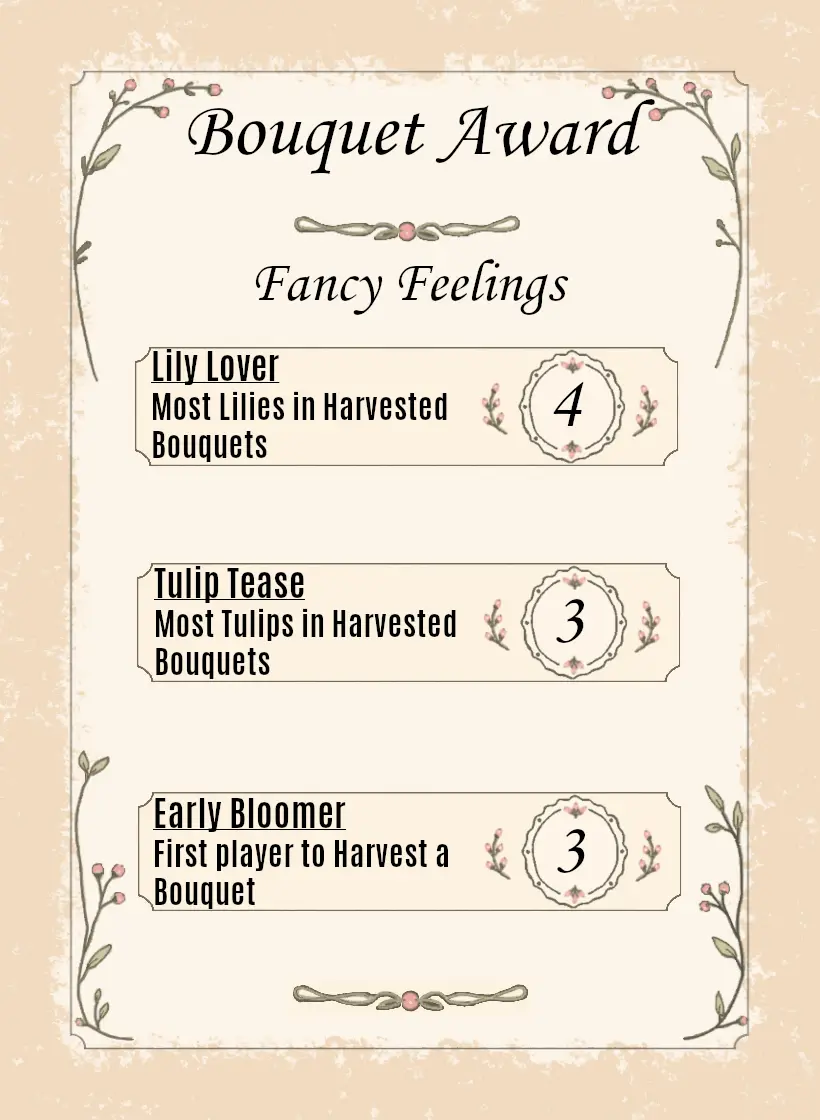
Fancy Feelings
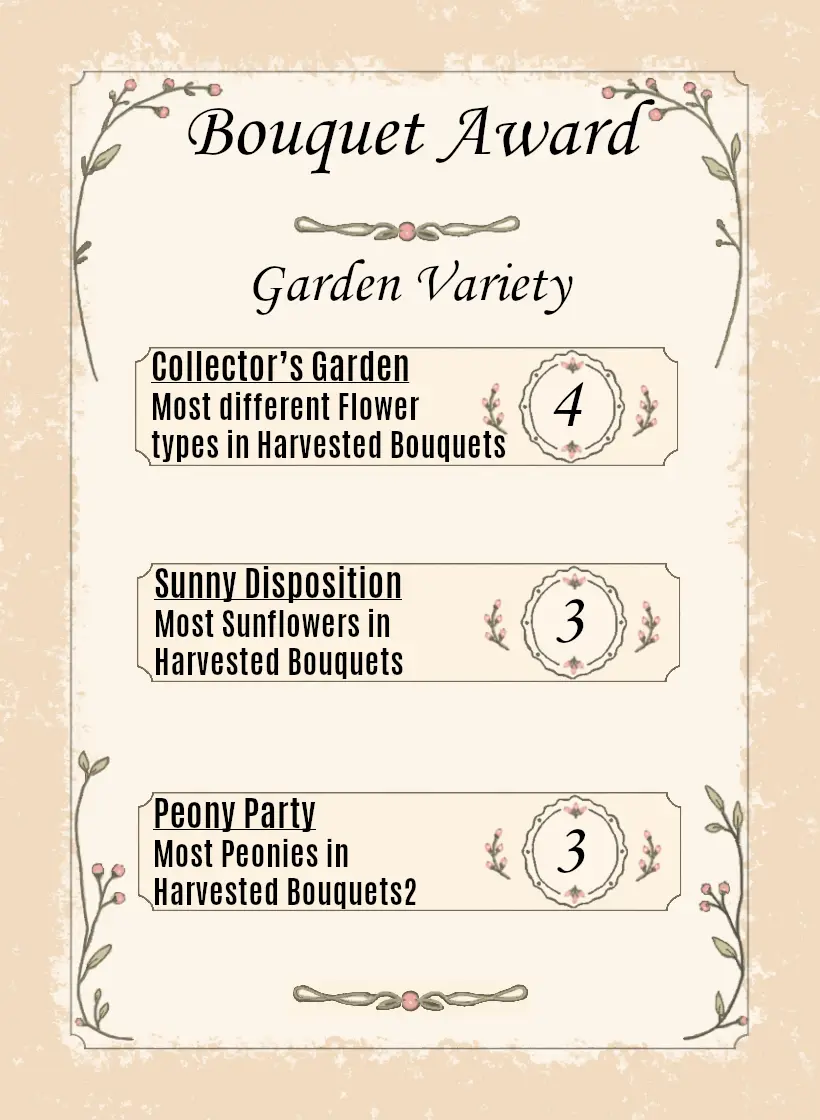
Garden Variety
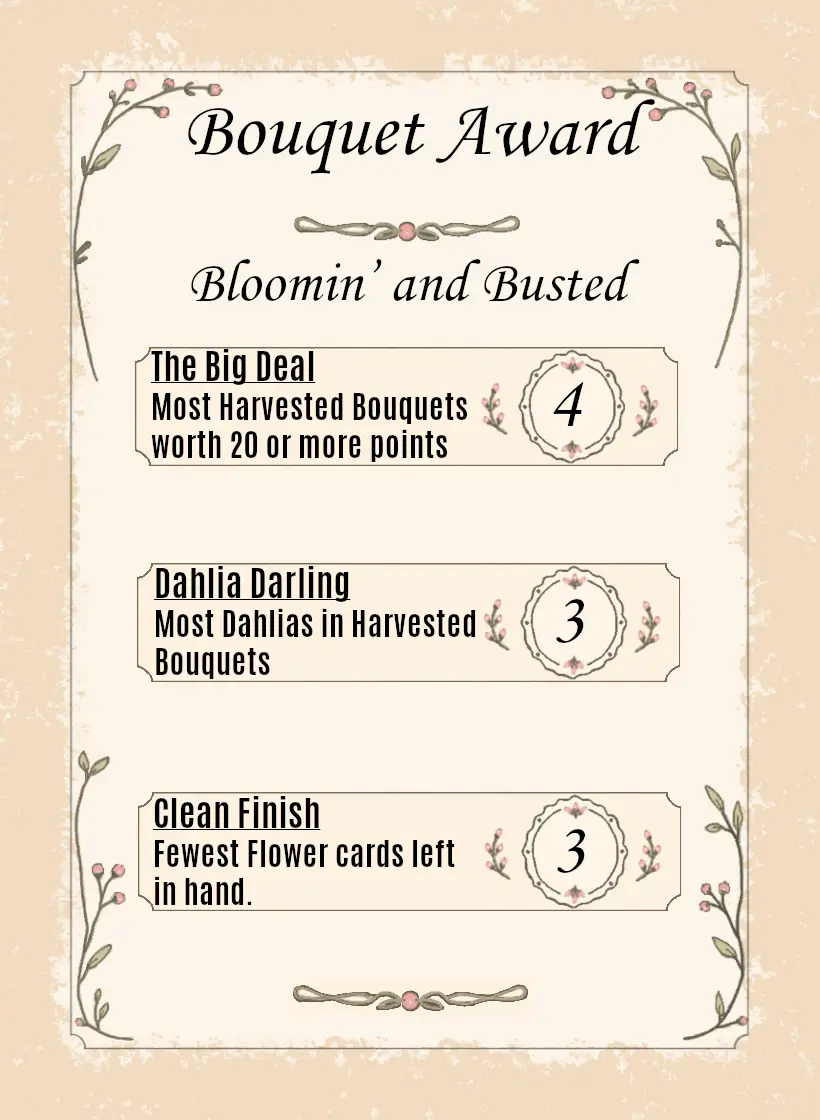
Bloomin’ and Busted
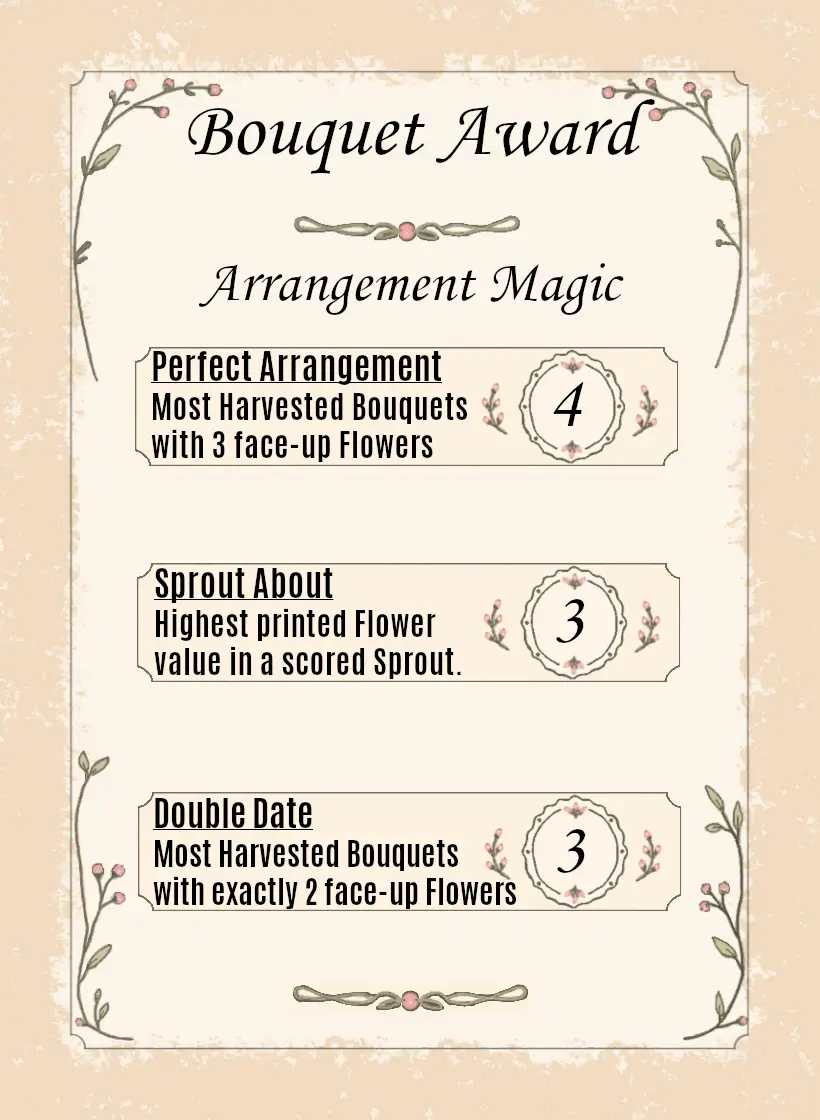
Arrangement Magic
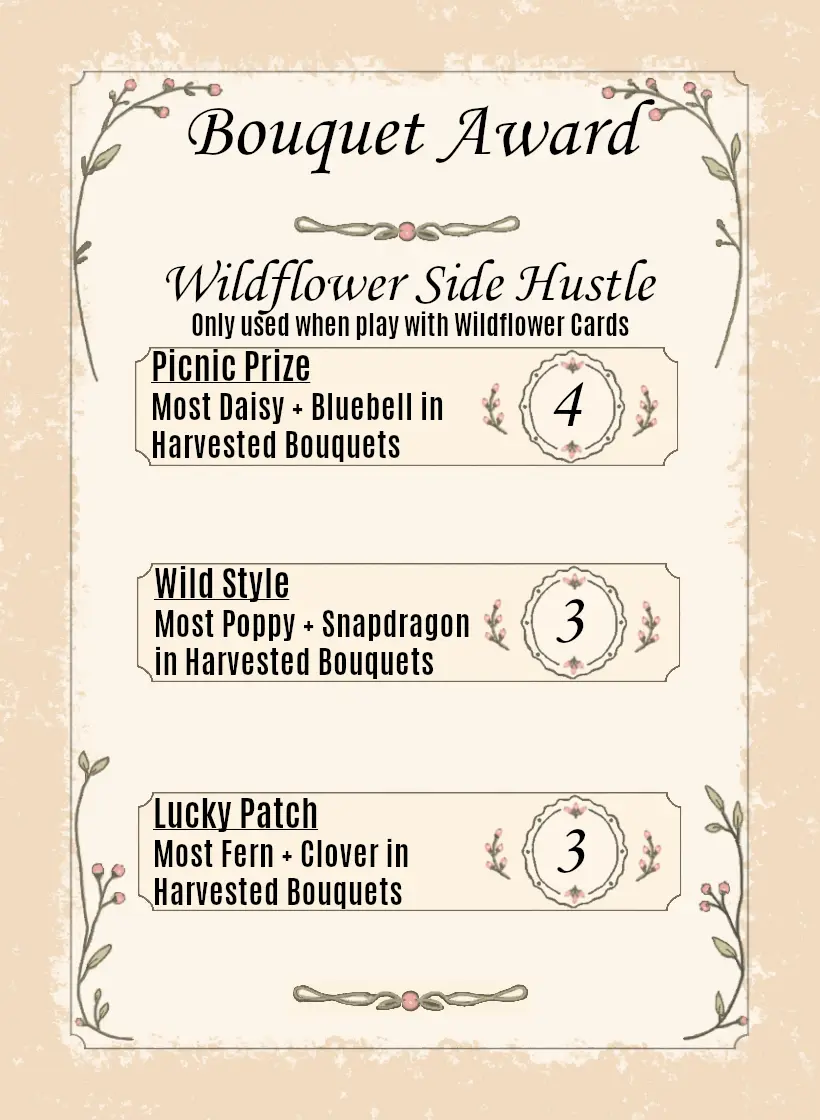
Wildflower Side Hustle
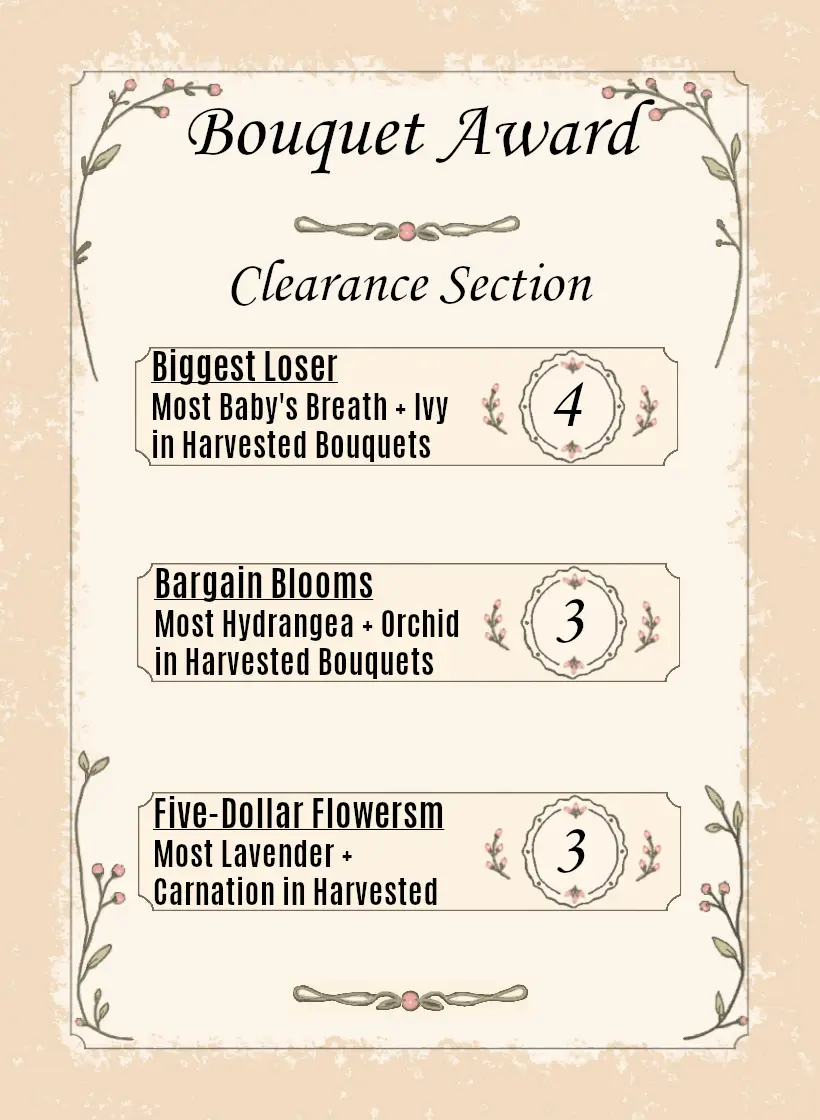
Clearance Section
FAQ
Do I have to Harvest if I can?
Yes. If you have a completed legal Flower Bed on your turn, you must Harvest. You may still play 1 Parlay card first.
Can I play a card instead of Harvesting?
Only if you cannot Harvest. If you have a completed legal Flower Bed, you must Harvest.
What if I have 2 completed Flower Beds?
Choose 1 to Harvest.
Can I play a Parlay card before I Harvest?
Yes. On your turn, you may play 1 Parlay card first. Then, if you can Harvest, you must Harvest.
Can I play Parlay cards during Final Play?
Yes. On Final Play, you may play 1 Parlay card first, then choose 1 action: play 1 card, Harvest 1 Bouquet, or pass.
Can I play Parlay cards during Final Harvest?
No. No Parlay cards may be played during Final Harvest.
Can I draw Parlay cards during Final Harvest?
No. Even if you Harvest a Bouquet with a Wildflower, do not draw a Parlay card during Final Harvest.
Can I draw Flower cards during Final Play?
No. No Flower cards are drawn after the Flower Deck is empty.
Can a Parlay card draw Flower cards during Final Play?
No. If a Parlay card says to draw Flower cards, that part does not happen during Final Play.
Can I draw a Parlay card from a Wildflower Bouquet during Final Play?
Yes. If you Harvest a Wildflower Bouquet during Final Play, draw 1 Parlay card. You cannot play it during Final Harvest, but it may score as an unused Parlay card.
What happens if the deck ends on the last player in turn order?
Go straight to Final Harvest. No one needs a Final Play because everyone already had the same number of turns.
What happens if the deck ends before the last player?
Finish the current turn. Then each player who still needs a turn this round takes a Final Play. Then go to Final Harvest.
Do my own Flowers block me?
No. Your own Flower Beds do not block you. Only opponents’ face-up Flowers block you.
Does Compost block?
No. Compost has no Flower type and does not block.
Does a Harvested Bouquet block?
No. Only face-up Flowers in Flower Beds block.
Does a Wildflower block?
If played as itself, yes. If played as a substitute, no.
How many Wildflower substitutes can I have?
You may have only 1 active substitute at a time. You get your Substitute token back when that Bouquet is Harvested.
Does a Wildflower used as a substitute score as the Base Flower?
No. It scores its own printed Wildflower value.
Does a Wildflower used as a substitute count as a Wildflower?
Yes. It still counts as a Wildflower.
Does a Wildflower used as a substitute draw a Parlay card when Harvested?
Yes, unless it is Final Harvest.
What happens to Favor tokens on a Bed at Season’s End?
If that Bed is Harvested, the Bed’s owner keeps the Favor token. If that Bed is still growing after Final Harvest, nobody receives or scores that Favor token.
Are unused Parlay cards worth points?
Recommended rule: yes. Each unused Parlay card is worth 2 points. Optional rule: 0 points if you want to push players to spend them.